





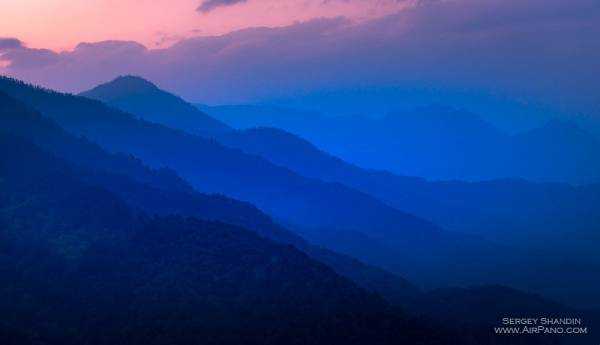
The Kingdom of Bhutan, or Druk Yul, the "Land of the Thunder Dragon," as the Bhutanese call it, is steeped in legends and rumors. The best way to verify what's true and what's fiction is to visit the country for yourself.
You can fly to Bhutan from Thailand, India, Singapore, or Nepal. Paro Airport is considered one of the most difficult airports in the world for takeoff and landing, as it is hemmed in by mountains and has a very short runway.

Until 1974, entry to Bhutan was only possible with a personal invitation from the king or queen. It's much easier now, but an economic approach is used to regulate tourist flow: a fee must be paid to a licensed tour company for a stay in the country. The package includes accommodation, meals, and guide services. A portion of the cost (approximately $65 per day) is a royal tax, the proceeds of which are used for Bhutan's social needs, such as healthcare, infrastructure development, and so on.
Our goal was to photograph landmarks with a drone, and we began preparing for the trip well in advance. Until recently, the use of such devices was prohibited in the country. We were delighted to learn that we had received the permits.
The plane makes a steep landing; houses and trees on the mountain slopes flash by outside the window, and here we are in Paro, in mysterious Bhutan! The next day, the first flight is planned near the Paro dzong (as the fortress-monasteries are called).
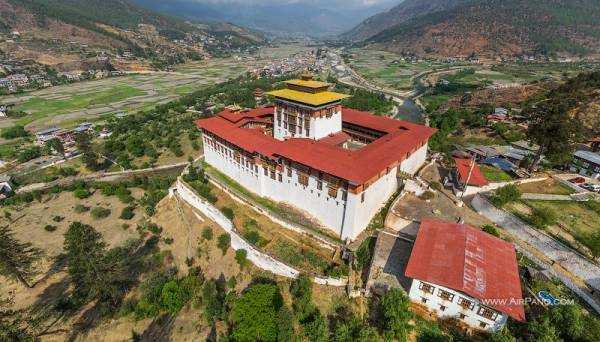
We're receiving additional instructions from the aviation security service: don't fly too close, don't fly over the roof, and don't fly with airplanes or helicopters—the airport is only a mile and a half away. The sun is shining, the wind is whipping clouds over the slopes of the Himalayas, and the impenetrable walls of the dzong rise up. Stanislav launches the drone, and we begin filming. It's beautiful!
Five minutes later, the police arrive and ask what we're doing there. We show them all the paperwork and permits; an aviation security inspector is also with us, confirming that everything is in order. However, time passes, more police officers and aviation officials arrive, and a quick resolution is clearly not expected. Eventually, we move with all our gear to the civil aviation office, where it turns out that despite having all the necessary documents, there's a regulation prohibiting drones from flying in Paro. Case law in action.
As a result, all existing permits are suspended and must be reapplied for. Until then, they cannot be removed.
Our friends at White Umbrella Tours, who organized the trip, pulled off the incredible feat of obtaining new approval from the necessary authorities in just a couple of days. We were overjoyed, but too soon: now the stack of documents had been updated with an addendum, containing a list of no-fly zones, including all the major monasteries, dzongs, and large settlements... So, all that was left was to photograph nature, which, frankly, was hardly different from our own North Caucasus.
Filming from the ground was also possible. But the video couldn't be taken closer than 200 meters from the dzongs. Checkmate! We had to completely rework the filming plan, eliminating all the dzongs.
While our guides were busy obtaining the necessary paperwork, we hiked to what is arguably Bhutan's most famous monastery, Taktsang Lhakhang, or "Tiger's Nest." Legend has it that Guru Rinpoche flew here on the back of a tigress, hence the name. The monastery clings to a cliff at an altitude of 3,120 meters, and the climb to it requires a hike along a mountain trail. Without acclimatization, it's a challenging journey, but our guide, Karma, encourages us.
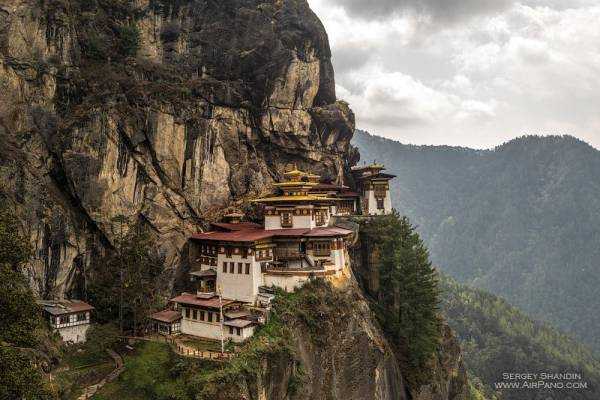
And so, after an hour and a half of climbing up the mountain, the monastery opens up before us. We undergo a thorough security check at the entrance: not only are cameras not allowed inside, but even phones are not allowed. After exploring the temples, we descended into the cave where Guru Rinpoche once meditated and drank sacred water flowing from the rock. The return journey seemed a little easier.
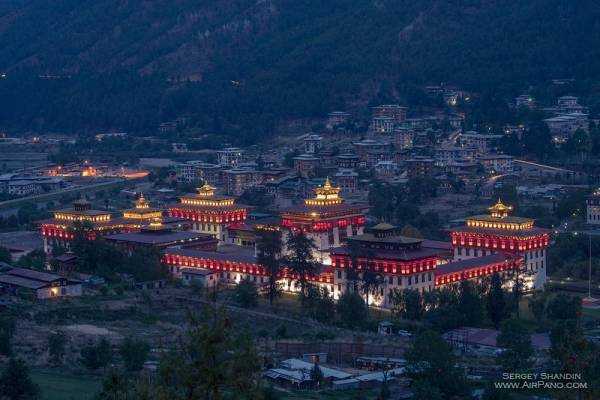
From Paro, we headed to the capital, Thimphu. The city is quite busy, but there aren't a single traffic light; traffic controllers direct traffic at intersections. The capital is home to the king's residence. Thimphu Dzong is very beautiful, and in the evening, its towers are illuminated. Unfortunately, we couldn't photograph all this from the air either.
The next day, we visited the Simtokha Dzong on the outskirts of Paro. This is the first dzong built by the Shabdrung himself, the founder of Bhutan. We were fortunate to meet a soldier there. I'm not very familiar with the insignia of the Bhutanese army, but judging by everything, he was a high-ranking officer. We got to talking, and he invited us to come with him and see something they don't show tourists. We called a monk, who opened the door to the room where the Shabdrung's father lived and died.
We also had the chance to see the sacred royal crown, kept in the monks' study room. Simthok Dzong was besieged during the Tibetan war and captured. The victors gathered in the central temple, but it collapsed on them, and they perished. It is said that this was the place's protective spirit interceding for its own.
Finally, all the permits are in place, and we head further inland. The road is under repair, the asphalt has been removed along its entire length, and the car trudges along the dusty serpentine, passing herds of cows and oncoming trucks. The Dochu-la Pass at 3,116 meters awaits us, where we'll spend the night.
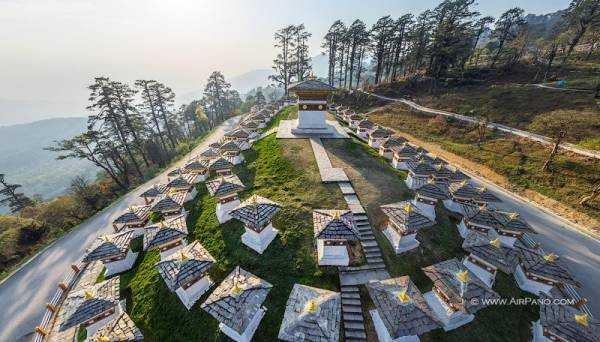
After the heat of Paro and Thimphu, the dawn on Dochu La is refreshingly fresh. The sun breaks through the haze, illuminating the mountains and 108 chortens. Branches burn in the ritual incense stove. Stas launches the drone, and filming begins. The stupas on the hilltop look stunning in the morning light.
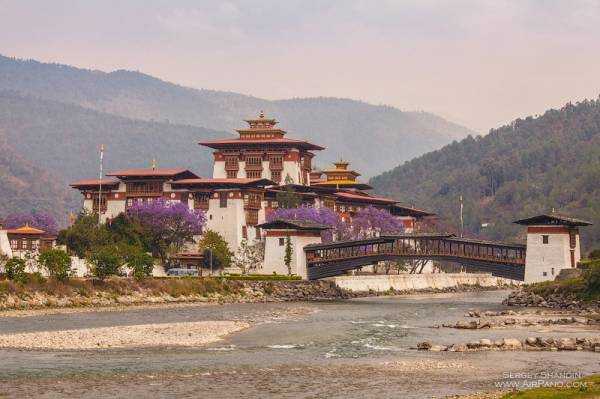
Our next stop was Punakha, a beautiful riverside dzong surrounded by flowering trees. It's also the winter residence of Je Khenpo, the head of the country's clergy. Royal relics are also kept here. Unfortunately, Punakha Dzong is on the "black list": we can only take photos in the courtyard and video from the opposite bank.
After sunset, we arrived in Gangtey, famous for its bird sanctuary. But we were more interested in the Gangtey Gompa monastery, so we headed there in the morning. There, we were introduced to the lama, and after some negotiations, we received permission to launch a drone.
After filming, we visited the monastery itself and its main church, and then were invited to see something unusual. Following a monk, we climbed a steep wooden staircase with narrow steps to the second floor. Our eyes adjusted slightly to the dim light, and we entered a small room.
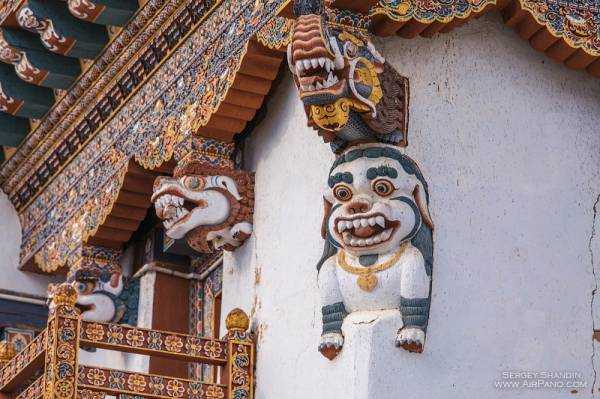
An altar runs along the wall. Figures of military leaders with dark, menacing faces stand on either side. Iron hats perched on their heads. The flames in the lamps, fueled by cow oil, flicker, and at times the figures seem to move. To the left of the altar, weapons hang on the wall: from ancient swords to a modern machine gun with a fixed bayonet. Some kind of monsters stare down from the right wall. I approach closer. Sure enough, they are the dried heads of various animals, tusks, and horns. Here is the grinning head of a leopard, its skin shriveled, making its menacing fangs stand out even more. Here is the head of a buffalo, and next to it, a wild boar. The beak of a hornbill is also visible. A giant fish, resembling a catfish but with enormous, sharp teeth, hangs from the ceiling. The monk explains that these are all defeated demons, collected as trophies.
My gaze falls on something strange; I flinch… I wasn't imagining it: it's a human hand. On the wall, almost under the ceiling, to the left of the "trophies," hangs a strange creature. At first, I thought it was a monkey, but no, the skull with its dried skin is completely human, albeit small. A long body, narrow palms and feet. The blackened skin is stretched taut over the bones, but there is no decay; the facial features and hands are preserved. A small person, but not a child—the proportions are different. An eerie sensation, especially when combined with the rest of the bestiary. This is a tseluchup, a creature similar to a hobbit, as we were told. Also a demon.
I read something about tribes of dwarfs found in the Himalayas—they were mentioned by 19th-century travelers. Perhaps this was one of their tribe, who had the misfortune of falling into the hands of a lama who thought him a demon... Many secrets are hidden behind the walls of ancient monasteries.
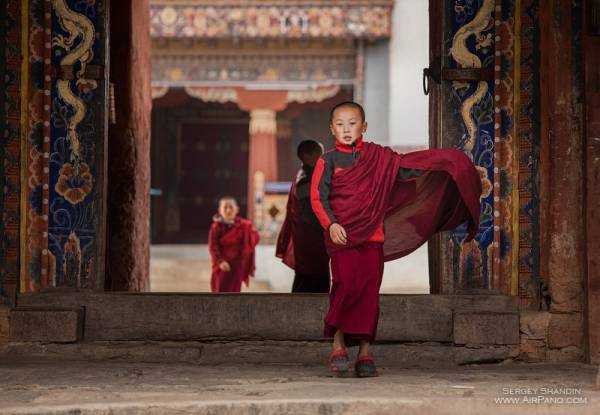
After Gangtey, we headed to Bumthang Province. It's a beautiful area, also known as the "Switzerland of Bhutan." Here we visited Thangbi Lhakhang Monastery. The lama greeted us very warmly and allowed us to photograph the puja—a prayer ritual. Photography is usually not permitted inside temples, but they made an exception for us here.
We spent two days at the monastery. We attended religious ceremonies, drank tea, and in the evening played various games with the monks. For example, you have to lift and carry a stone weighing almost a hundred kilograms. If you carry it all the way around, all your sins are wiped out. I only managed a quarter of the way around.
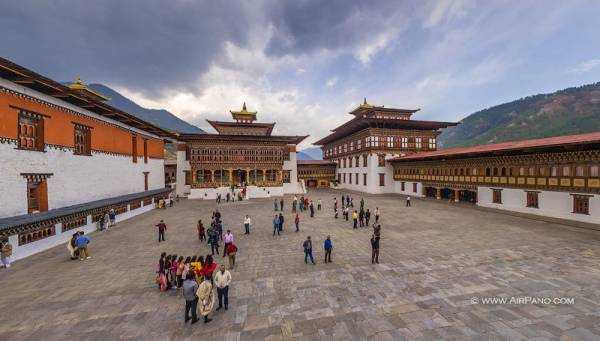
Bhutan is a very interesting and distinctive country; stories about it could go on and on. One of its most striking differences from other countries is its legally enshrined pursuit of happiness. In 1972, King Jigme introduced the principle of Gross National Happiness: here, this priority trumps Gross National Product, the foundation of life in all other countries.
The country is currently ruled by his son, Jigme Khesar Namgyel Wangchuck, who ascended the throne in 2006 at the age of 26, becoming the world's youngest reigning monarch. He continued the tradition of valuing happiness above wealth.
Historical values—both cultural and spiritual—influence the lives of modern Bhutanese. The country is proud of its forests, flora, and fauna, so environmental conservation is a key component of the National Happiness Program. Furthermore, the road to national happiness includes education reform, mandatory English language instruction, environmentally friendly road construction, care for the elderly, state protection of monasteries, a ban on smoking, a ban on chemical fertilizers, street cleanliness, flower cultivation, and much more.
We would like to thank the company for their help in organizing our trip. White Umbrella Tours, and personally Natalia and Tashi Wangdi, our guide Karma Yunten, driver Karma, as well as everyone who helped us and supported us.
Source: travel.ru