





This was AirPano's second trip to Venezuela, but that didn't make it any easier. We chose the worst possible time to travel: Venezuela was in the midst of an economic and social crisis. Most of our friends, upon hearing we were planning to go, discouraged us, and many simply thought we were crazy.

But now the transatlantic flight is behind us, and the aging Douglas is carrying us to Canaima. There are few passengers. Most of the cabin is taken up by our luggage, which didn't fit in the cargo compartment.
Canaima is a national park in southeastern Venezuela, virtually cut off from civilization. Access by land is impossible: there are no roads. Only by river or plane.
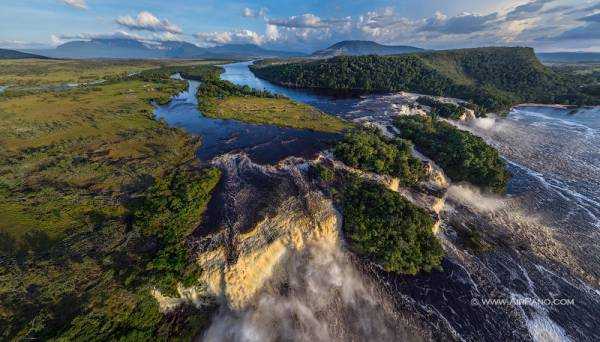
In the distance, the Canaima Lagoon and the table-top mountains—tepuis—come into view. We've arrived!
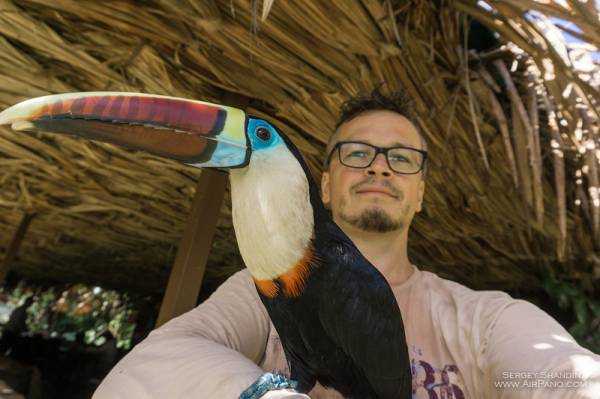
We transfer from the plane to a truck, which, bouncing merrily over the bumps, carries us to a lodge on the shore of a lagoon. At the entrance, we are greeted by exotic parrots and a sociable tame toucan, who, as a sign of friendship, tries to rip a couple of toes off my foot with his beak. Tomorrow, we plan to fly to Angel Falls by helicopter from here, but for now, we'll take a short rest from the road.
The first news wasn't good: the helicopter was damaged and awaiting repairs, so the flight will have to be postponed. Well, we'll spend the day filming in the lagoon.
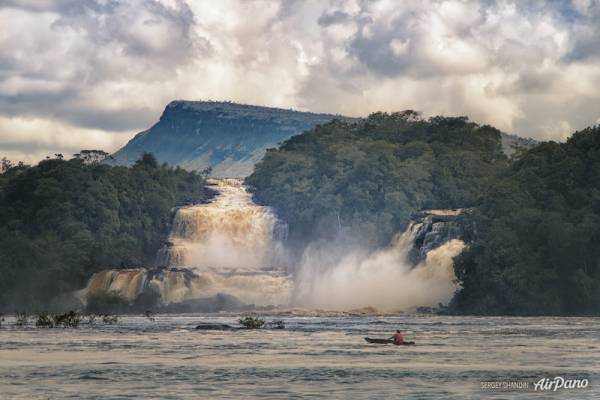
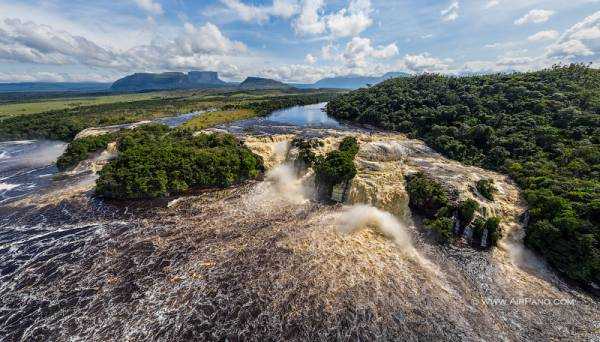
Surrounded by beaches and waterfalls, Canaima Lagoon is incredibly picturesque. The largest waterfalls are Acha, Golondrina, and Ucaima, the smaller Sapito and Sapo, and the large Ara Rapids.
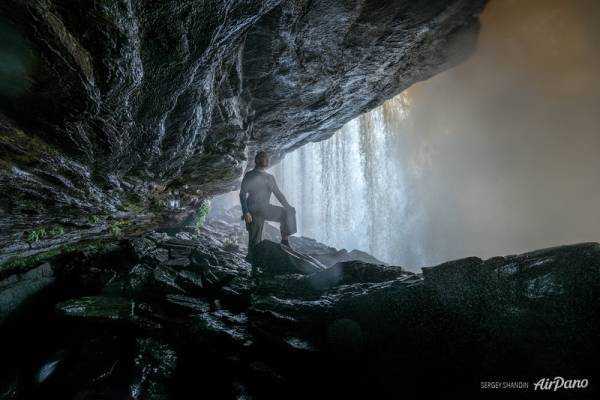
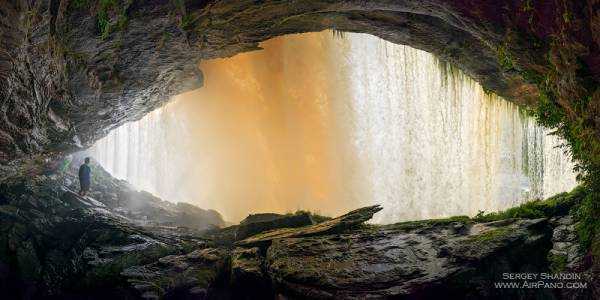
Accompanied by our guide, Nicholas, and an Indian boatman, we set off for Hacha Falls, located on the opposite side of the lagoon. Hidden behind the raging wall of water is a tunnel through which one can pass right through the falls. At first, we're a little uneasy: after all, nothing can be seen beyond the spray, and we're stepping into the unknown. But after overcoming the thick current of water, we find ourselves in a damp cave, overgrown with vines at the entrance. Surprisingly, it's quite bright inside: the sun filters through the streams of the waterfall, reflecting light off the walls. It's a good thing we brought plastic bags to hide our camera equipment! Water is pouring from everywhere: it feels like the spray is coming not only from above, but from all sides. And although filming here will be quite difficult, we'll give it a try.video).
Depending on the thickness of the wall of water, its color changes: the right side of the waterfall is almost transparent, with a blue sky peeking through. The dense left side, however, pulses orange; there's so much water here that its roar drowns out our voices, and the fine spray swirls into eddies.
It felt like a long time had passed before we passed through the waterfall. And then we saw the sun again and were climbing a steep mountain. Our goal was to capture the waterfall from above using a drone.
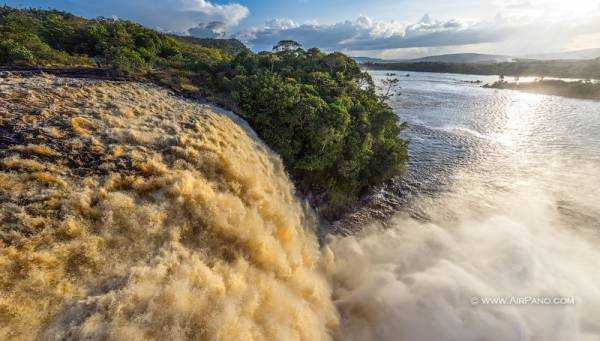
After climbing a wet and slippery slope, entangled with vines and roots, we emerge onto a rocky, level cliff. From here, we have a clear view of the waterfall and the entire lagoon. Stas launches the drone, and we make several passes at different heights, sometimes lowering the device almost to the edge of the waterfall. Powerful jets of water break into splashes, creating beautiful rainbows.
Meanwhile, the sun is setting, and Nicholas says, "Get ready, our little friends are coming soon." Seeing our confusion, he smiles and explains, "The puri-puri are coming. Those little midges. They're really nasty. They bite."
It's worth noting that traditional mosquitoes, similar to our own, weren't very aggressive in Canaima. But the puri-puri...
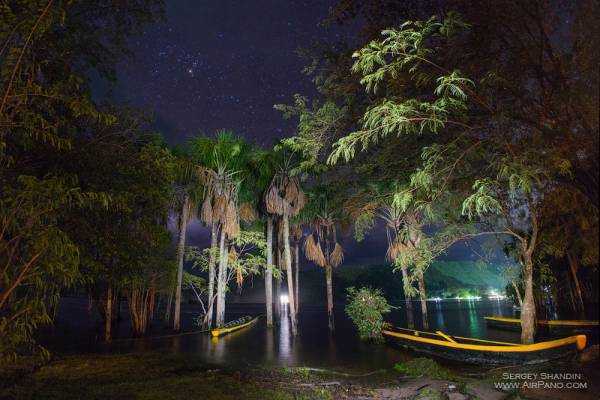
The sun had almost set, but we still had to get back to the boat… We passed through the tunnel under the waterfall again, took another shower, descended to the lagoon, and then a wooden boat with a powerful motor sped us back. It gets dark quickly in equatorial latitudes; we moored in the dark. The wind swayed the palm tree tops, and bright stars appeared above them.
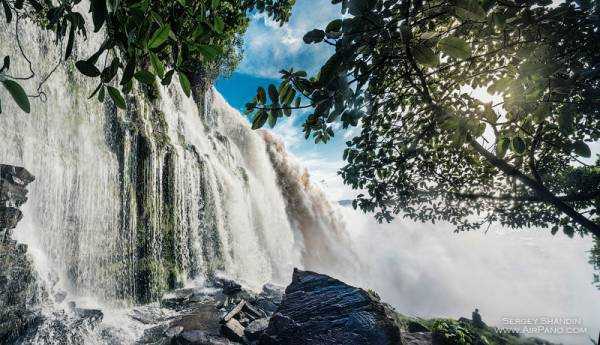
The next day, we didn't get the helicopter again, so we headed back to the waterfall, now better prepared for filming inside the water grotto. The water in the waterfall is quite warm, but the air in the grotto isn't heated by the sun, so we went outside a couple of times to warm up.
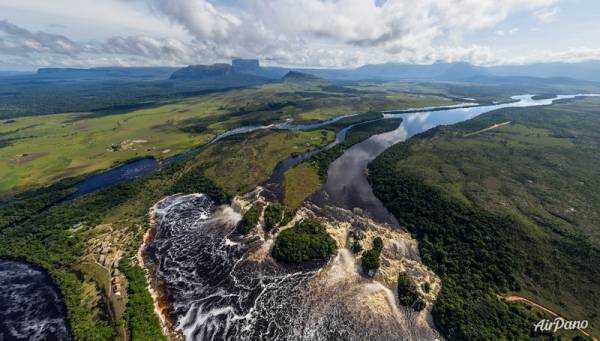
The biggest problem is the splashes. They coat the lens filters in droplets within seconds. But the picture is truly mesmerizing; I wiped the lenses with a wet sleeve, taking more and more takes. But the puri-puri inside the waterfall is not scary!
Only the next day did the helicopter finally reach Canaima, and it was time to head to the majestic Angel Falls. Flying over Acha Falls, we waved to him like an old friend.
Source: travel.ru