






In Königsberg (Kaliningrad), some of the fortifications of the Second Rampart Defensive Wall, construction of which began in 1843, remain intact to this day. The architect of the fortification system was General and fortification engineer Ernst Ludwig von Aster, under whose supervision new bastions, gates, and an earthen embankment were built. At the beginning of the 20th century, the fortifications of the Second Rampart Defensive Wall lost their military significance and were either sold to the city or demolished. The remaining fortifications were reinforced during World War II and used in the defense of Königsberg in 1945. Part 3 of this article examines the Oberteich Bastion, the Grolman Bastion, the Kronprinz defensive barracks, the Lithuanian Rampart, and other fortifications.
Scheme of fortifications of the Second Rampart Defensive Encirclement (19th century)

The fortifications of the Second Bypass, present in Part 3 of the article, on a modern map

Bastion Oberteich, reduit. The Bastion Oberteich was built between 1856 and 1860 according to the designs of the Chief of the Engineer Corps, General of Infantry Ernst Ludwig von Aster (his image is on the Brandenburg Gate). It received its name from its proximity to the Upper Pond (Oberteich).

Accidentally captured an accident

Some people were unlucky

The Lithuanian rampart between the Oberteich and Grolman bastions

A closed postern in the Lithuanian Rampart. A postern is an underground corridor (gallery) for communication between fortifications, fortress forts, or strongholds of fortified areas.

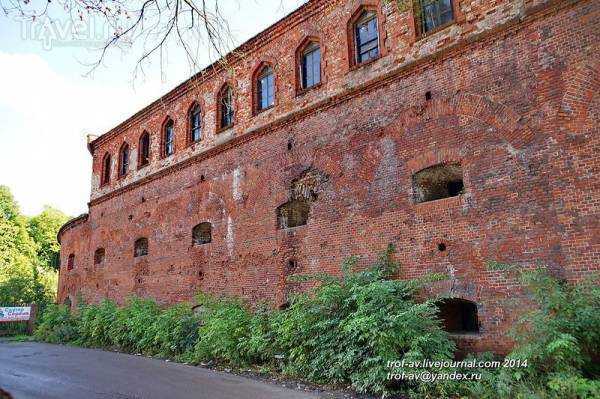
The Kronprinz defensive barracks, built between 1843 and 1849, was designed by Ernst Ludwig von Aster. The barracks served as a redoubt to block the enemy once they had already invaded the city. At various times, it housed elite units of the Königsberg garrison, residential quarters, the Königsberg police, the Wehrmacht's military treasury, warehouses, and various city services. In April 1945, fighting raged near the barracks walls, but the barracks itself was not stormed and remained surrounded by Soviet troops until the general capitulation. After the war, the barracks housed a penal battalion that took part in the assault on Königsberg, a tank repair training regiment, and later a naval school, a dormitory, fishing industry organizations, warehouses, and stores.

Local thugs, their eyes seem to be looking for something to squeeze out of you.

Until 1933, the 1st Infantry Regiment (Ostpreussisches Grenadier-Regiment 1 Kronprinz) was stationed in the Kronprinz barracks; from 1933 to 1945, the Königsberg police and troops of the Königsberg garrison were stationed in the barracks; from 1950 to 1960, the 27th separate tank repair regiment of central subordination and the training and automobile battalion of the tank division were stationed in the barracks.

Information board about the Kronprinz defensive barracks

Near the barracks there is a monument to a fisherman, who was absent at the time of filming.

A sea anchor that lay near a fisherman

A memorial plaque "Fortress of Frederick the Great, 1759" on the wall of the barracks


Branch of the Moscow State University of Technology and Management named after K.G. Razumovsky

Note the brickwork

The Crown Prince from the side of the Lithuanian Wall and the Grolman Bastion


The Kronprinz Barracks in 1945

The rupture of the Lithuanian rampart at the redoubt of the Grolman bastion

It's from the side of the Grolman bastion, on the other side of the road you can see the Kronprinz barracks

The Grolman Bastion's redoubt. Built in 1851 according to the designs of Ernst Ludwig von Aster, the Grolman Bastion was named after General Karl Wilhelm von Grolman, a reformer of the Prussian army. During the fighting in 1945, Grolman housed the command post of the Wehrmacht's 367th Infantry Division, and the fortification suffered significant damage. After the war, it housed a vegetable warehouse. In March 2007, the bastion was designated a cultural heritage site (of regional significance).

Source: travel.ru