

The Northern Lights, or Aurora Borealis, occur during periods of solar activity: during these periods, the sun releases millions of tons of particles into space, which, after a few days, reach the upper layers of the Earth's atmosphere, rich in nitrogen and oxygen. The result of this "encounter" is a colorful glow of the atmosphere near the Earth's poles.

Our planet has two poles, so the aurora borealis occurs not only in the north but also in the south. They are best visible at latitudes around 67-70°, but this part of the Southern Hemisphere is sparsely populated, making the aurora australis almost impossible to observe. In the more densely populated Northern Hemisphere, however, millions of people in countries ranging from Norway to Russia admire the aurora borealis. And the further north you go, the more spectacular the display will be.
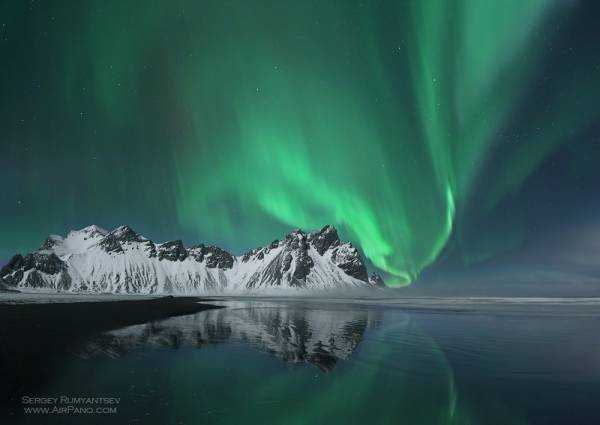
One of the best destinations is Iceland: an island in the Atlantic Ocean near the Arctic Circle, located at 65° north latitude. Unlike its direct competitors—Sweden, Norway, and Finland—the country boasts a mild climate, meaning you can admire the vibrant colors above without the bitter cold. This is thanks to the Gulf Stream, which makes Iceland's weather relatively warm: in winter, temperatures in Reykjavik rarely drop below minus 5°C.
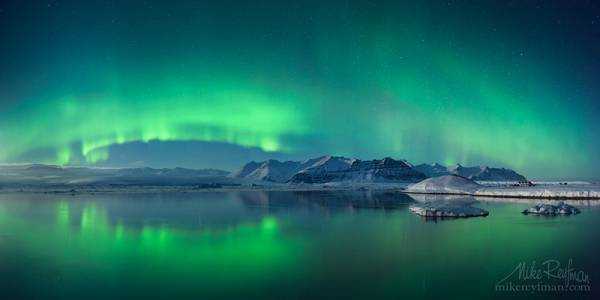
The stronger the northern lights, the brighter and greener their play across the sky. Weak auroras don't look like colorful postcards at all; they're gray and very reminiscent of wispy clouds. But powerful auroras create a lasting impression, painting everything around them green.
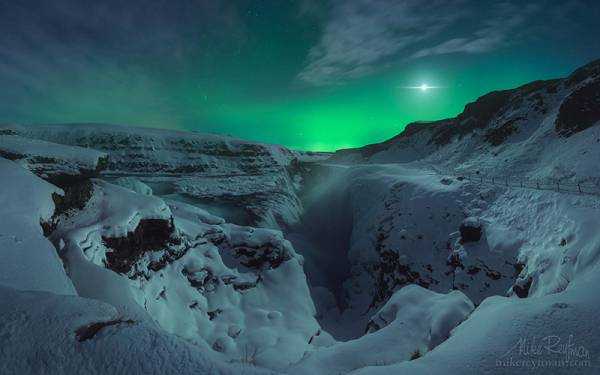
It can be observed during a full moon and even in a large city with strong light pollution. However, to fully appreciate the beauty of the aurora's colors, it's best to travel at least 50 kilometers from a large city, and at least 5-10 kilometers from a small village. Unfortunately, even a strong aurora may be hidden due to cloud cover. Clear weather is crucial for observing the aurora—the weather in Iceland is extremely variable, so it's essential to closely monitor cloud forecasts to determine the best spots.

According to ancient Icelandic legends, the aurora borealis occurs when elves on earth dance and rejoice. Among the northern peoples, there was also a widespread superstition that whistling or singing at this time would anger evil spirits, who would inflict paralysis or blindness in retaliation. But no dark beliefs deter those eager to admire this cosmic phenomenon.
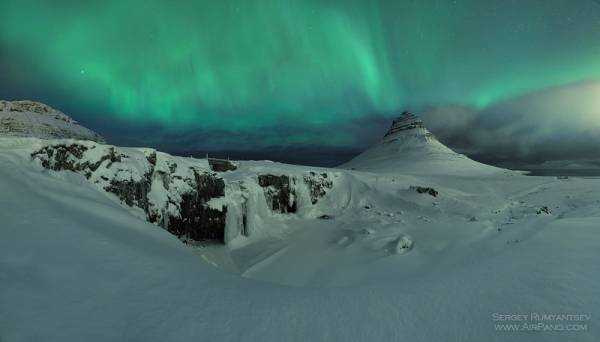
The auroral season is considered to be the period from September to March, between the autumnal and spring equinoxes. At high latitudes during this time, night lasts 18-20 hours, and even faint auroras are quite clearly visible. However, don't assume the sky is guaranteed to be illuminated by bright flashes every winter night: first, the Sun must release particles, and only then, after 3-5 days, will they reach the upper layers of the Earth's atmosphere.

Another advantage of Iceland is that even if you fail to spot the Northern Lights, you won't be disappointed: the famous waterfalls and black volcanic beaches, thermal springs and glaciers will delight your gaze. And our panoramic views will allow you to see this colorful phenomenon at any time of year, anywhere in the world, without the slightest effort!

Photographing the Northern Lights isn't easy. Being close to the Arctic Circle isn't enough—three other important factors must come together:
- solar activity,
- cloudless sky,
- interesting foreground.
These panoramas were shot in Iceland, where, given the country's renowned photogenicity, foregrounds shouldn't be a problem. We monitored the Northern Lights using a dedicated website that provided a relatively accurate daily forecast of solar atmospheric disturbances. We also checked the weather online hourly, especially the cloud map. Both forecasts were about 70 percent reliable, but the likelihood of seeing a colorful sky was still high if all conditions were right.
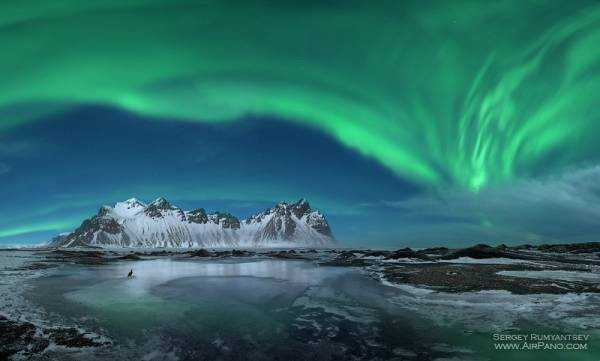
During the two weeks allotted for our Icelandic tour, we were only promised solar activity a couple of times. In the north of the country, near Lake Mývatn, lies the fascinating Godafoss waterfall. Once there, we decided to spend a couple of days (or rather, nights) hunting for the aurora borealis. The forecast showed activity—admittedly weak, but the sky promised to be clear. We managed to find a decent hotel, 10 kilometers from the waterfall and with its own heated outdoor pool. After a day of shooting, we had dinner and went to warm up in the thermal water that flows directly from the springs into the pool. But as soon as we immersed ourselves in the warmth (even though it was -17ºC outside), someone noticed a strange streak in the sky, not quite cloud-like. It's worth noting that when the aurora is weak, it appears to the naked eye as a gray haze, but a camera sensor reveals a green tint. We jumped out of the water like a bullet and 10 minutes later we were already driving to the waterfall.
That night we managed to catch a few interesting flashes in the sky, but overall the aurora wasn't very strong. More or less the same thing happened the next night, and on the third we stayed in the pool longer: the faint streaks in the sky no longer interested us. But when their color began to change from grayish to green, we realized we had to quickly trade the bliss of the warm water for the shivering in the piercing wind.
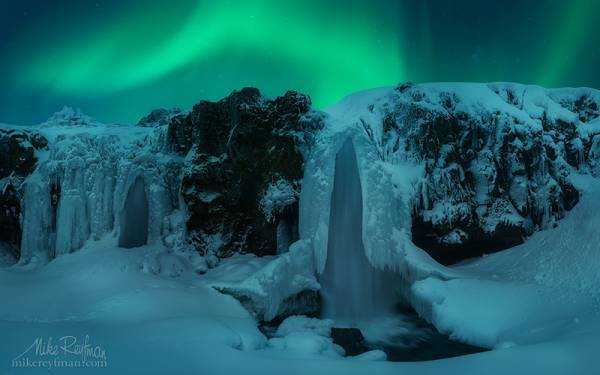
Several photographers were already at the waterfall. The aurora grew brighter before our eyes. At first, it appeared in streaks near the horizon, then began to manifest itself above our heads. Shades of purple and yellow appeared. Suddenly, a true light extravaganza began. Fantastically vibrant images unfolded in the sky: the aurora sometimes resembled a dragon with outspread wings, sometimes an Indian in a headdress of multicolored feathers, and sometimes it scattered like fireworks sparks in a dome across the sky. I stood paralyzed, shouting something in delight and periodically pressing the shutter, completely disregarding the foreground. The light show lasted three minutes, and then just as suddenly died down. The streaks that remained in the sky were nothing compared to what had happened before!

After this incident, the forecast and the sky were completely disappointing for almost a week. Something must have been happening high above, but the sky remained overcast, giving us no chance. However, the forecast changed the day before departure. The strongest disturbance in the solar atmosphere was predicted to occur the night before our flight to Moscow. Luckily, the peninsula where Keflavik Airport is located was the only spot not obscured by clouds. Arriving a couple of hours before the scheduled shoot, we explored several possible foregrounds: a small church (it turned out to be heavily overexposed by the spotlights), a small port (also full of lights), and a frozen lake (it might have made a nice reflection, but there were no hummocks or rocks to add variety to the landscape). At the tip of the peninsula, we came across an old lighthouse. It had been out of service for many years and was likely a museum, but behind it stood a modern lighthouse, whose spotlights effectively illuminated the object of interest.
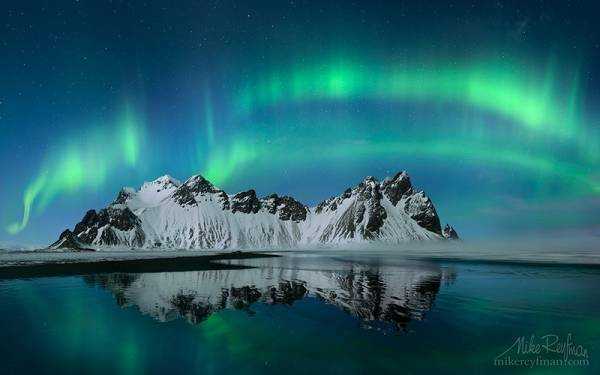
As soon as we had surveyed the area, the first glimpses of the northern lights appeared, an hour earlier than predicted. It was time to break out the lenses.
The aurora is unpredictable: it can occupy just a small section of the sky in a band, or it can "flutter" across the entire "dome." So, to capture all the details, I used a Nikkor 14mm 2.8 lens. But even with such a wide-angle lens, I had to take several shots to stitch them together into a panorama.
I manually adjusted the focus using Lifeview using a working beacon and sealed the ring with tape so as not to accidentally touch it in the dark.
I set ISO 2500 as a compromise between high sensitivity and low noise. I stopped down the aperture one stop to f3.5 and experimented with the shutter speed. The aurora is a very dynamic phenomenon. Parts of the sky constantly shimmer, and the scene can completely change in a matter of minutes. To provide enough light without blurring the aurora, I chose a shutter speed of 10 seconds (remember, I was creating a panorama of several shots).
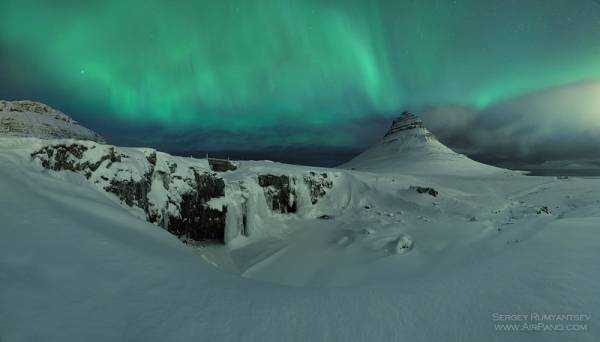
In half an hour, I managed to take a dozen panoramas. The sky would sometimes blaze in stripes, sometimes twist into whole sheets, and then everything would be covered in a green haze.
But the main goal of the evening was to shoot a high-resolution 360° timelapse video of the northern lights. Our technicians at AirPano had crafted a special device, affectionately nicknamed "Gorynych," specifically for this purpose. Setting it up and configuring it wasn't easy, but the goal was too important. Besides, we weren't used to giving up. After about 15 minutes of fiddling, I managed to assemble all the equipment, configure it, and even set it up in a beautiful location. My biggest concern was the strong wind, which not only rocked the tripod but could also simply blow away our "Gorynych." So, after the launch, I had to regularly check on it. When it finished, I couldn't even believe how smoothly it had gone: the conditions were so extreme.
The batteries in the Gorynych died just as the sky began to "blaze," and the Aurora began to noticeably weaken. We packed up our equipment and simply watched the rest of the show. We were lucky for the second time, although the spectacle was still nothing like the one at Godafoss.
We were flying back early the next morning; the forecast showed strong solar activity over the next few nights, but we decided not to change our tickets: we'd have a reason to return.
Source: travel.ru