

Petra - the greatness of decline
The road out of town was lit primarily by the full moon, and only secondarily by the lanterns placed along the side of the road. I walked in almost complete silence, unaware of what awaited me around the next bend. Strange, domed cliffs with caves carved into the rock, each containing a candle, offered me an unwelcoming, glowing eye socket as I entered the city of the dead they guarded. The path ran into the cliff face and became a narrow passage between vertical red walls. The moon could no longer illuminate anything, and I walked along the winding path, a long time and in silence, accompanied only by the dim light of the lanterns placed along the path, the wafts of a warm wind, and the rustling of lizards. Suddenly, a bright light appeared ahead; after a few meters, the cliffs parted, and I emerged into a square filled with candles. In the center stood a man, dressed in white down to his feet. He slowly raised his hands, and the flute's music began to flow. It snaked across the entire space, penetrating crevices, reflecting off the yellow-red rocks, and soaring into the endlessly starry sky. The majestic building against which the Arab stood—the Pharaoh's Treasury—dominated the surrounding space. Had it had walls, it could have been mistaken for an ancient Greek temple. But there were no walls. The façade, columns, porticoes, statues, and steps leading to the entrance to the dark interior had been carved with incredible precision directly into the rock... The bright flames of hundreds of candles spread across the square. It seemed (or perhaps it was) as if I were taking part in an ancient pagan ritual...

Petra... So I entered Petra for the first time several years ago...
A city living in four dimensions. Or rather, living... The mind refuses to accept that the overwhelming majority of breathtaking, majestic rock "palaces" are merely individual burials within a vast, centuries-old, and multinational necropolis. It was the custom in ancient times (and the Egyptian Pyramids are a striking example) for burial structures to last for millennia, temples and religious buildings to last for centuries, and domestic and residential structures to last for a time barely limited by a human lifespan, or at best, the lifespan of a family.
No, Petra was not created specifically as a necropolis: here, deep in the rocks, up to 20,000 people once lived, there were markets, baths, villas with swimming pools, an extensive system of water canals, theaters, government offices, a senate... It's just that time and earthquakes, wind and sand destroyed and hid all the vanity.
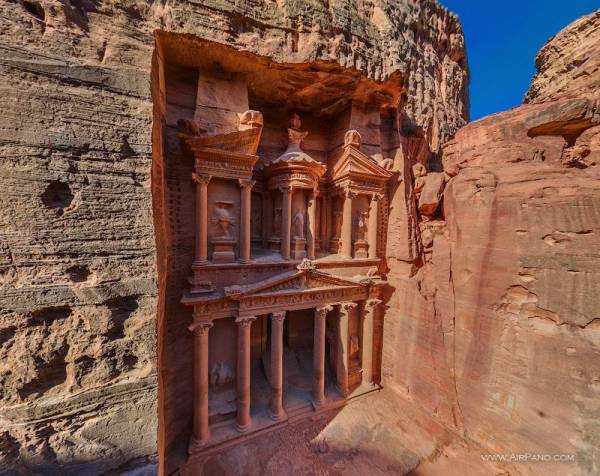
When you think about Petra, you want to introduce a special, “fifth” dimension, directed into the thickness of the rock: describing the rooms, caves, storage rooms, altars, altars and obelisks carved out of the mountain massif over the centuries in ordinary geometric terms seems absurd.
Mysteries of history
Everything here breathes time, as viscous as the stone steps leading to the enormous altar on the highest cliff of Zibbi-Attuf, soaked in the blood of thousands of years of human sacrifices to the sun god.
The Arabs who now inhabit Jordan view the Old Testament with suspicion as a historical document, and their guidebooks begin their descriptions with the settlement of the "industrious Arab tribe of Nabataeans" in the Valley of Moses in the 4th century BCE. A little later, the Greeks would name this area "Petra," meaning "rock" or "stone."
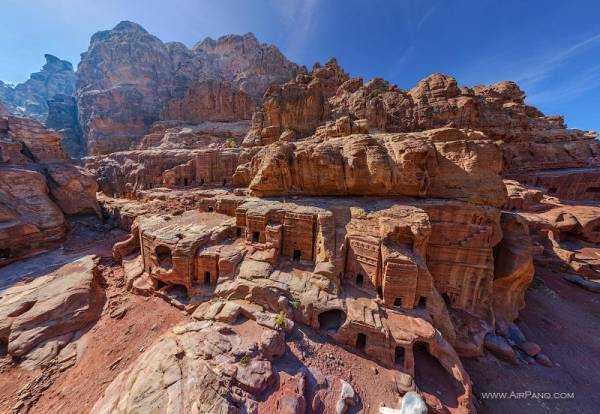
The Nabataeans' wealth came primarily from tolls on caravans, fees for their protection and escort, tribute from neighboring peoples, and banditry. Their influence extended from Sinai to Damascus, and rumors of a flourishing state attracted the attention of the Romans. They were initially unsuccessful in conquering Petra: the city was too well protected by the surrounding mountains, and the entrance to the city (then called the Siq), only 2-5 meters wide, was too easy to defend amid 80-meter-high sheer cliffs. However, in 106 AD, the Nabataeans finally lost the battle to the troops of Emperor Trajan.
Petra, now Roman, flourished for another couple of centuries, but with the development of shipping on the Red Sea, the city lost its importance, and the Romans abandoned it. The Byzantines arrived in Petra during its decline, and several particularly significant buildings were converted into Christian churches.

The Arab conquest of the city in the 7th century left little cultural or historical trace. The last mentions of Petra date back to the 11th century, during the Crusader Kingdom of Jerusalem, the ruins of whose fortress are located near the High Altar of Sacrifice.
Since then, Petra seemed to have vanished from the face of the earth. Only legends of countless Nabatean treasures hidden somewhere in a dead city in the Jordan Mountains, and the bloodthirsty Bedouins guarding them, were passed down by word of mouth.
Some parts of the legendary film "Indiana Jones and the Last Crusade»
Petra was discovered by the Swiss explorer Johann Ludwig Burckhardt in 1812. To do so, he had to learn Arabic and study the Quran. Outwardly, the adventurer looked like a Muslim. Perhaps this is why the Arabs agreed to show him the way to the rock city. Finding a guide was difficult: everyone was afraid to enter the city of the dead, which the Bedouins believed was inhabited by evil spirits. The guide led him to Aaron's Mausoleum to perform a sacrifice. After walking along a rocky corridor and emerging at the 40-meter Treasury carved into the rock, Burckhardt realized that this was the legendary Petra. His admiration nearly betrayed him as he began to admire the magnificent structures. The guide even tried to kill him, but the scholar's resourcefulness saved his life.
Stone city, city in stone…
Those who have visited Petra will agree that one day is enough to fall in love with and admire the city, but three is not enough to explore all its paths and see all its structures, from the Treasury to the enormous Deir Monastery, carved into the cliff face. After all, the Nabataeans alone left over 800 stone-carved monuments in the city.
The entrance to Petra is through the Siq, a dark, winding gorge. Along one wall runs a kilometer-long canal carved directly into it, which brought water from the Well of Moses to Petra. Ancient architects designed a complex system of dams, cisterns, and aqueducts to collect and retain moisture in this hot climate. Fountains gushed in the squares, and noble Nabataeans and, later, Romans enjoyed sunbathing by pools, the remains of which have been excavated by archaeologists... It was impossible to imagine this, looking at the utterly lifeless rocks under the scorching Jordanian sun.
Small carts and tourists rush past, but it's best to approach the Pharaoh's Treasury slowly. The façade of this most beautiful building in Petra first appears faintly through a gap in the rocks, then with each meter, it reveals itself more and more, until it stands gleaming in the sun in all its glory.
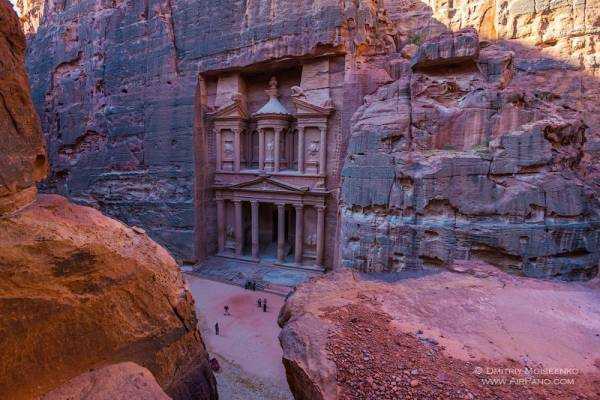
It must be said that the names of the monuments do not at all reflect their actual purpose and content. Since the Nabataeans left no city plan with names, the Arabs gave names based on myths, appearance, or simply guesswork. Thus, the Treasury was named after a legend about the rich loot of an ancient pharaoh, which was so heavy that it slowed his army's march east; most of it had to be hidden in the rocks... The bowl crowning the building bears bullet marks from Bedouins, certain that this was where the gold lay: all they had to do was crack the bowl, and a shower of precious stones would fall upon them...
Behind the columns are doors leading to the inner chambers. These small rooms are believed to have served as the burial chamber of the great Nabataean king Arepa IV, during whose reign the city reached its peak, including in architectural achievements. The color scheme of the interior is striking: sandstone incrustations, ranging from white to burgundy, seem to be smeared by nature's brush across the tomb's walls. The façade of this structure, 30 meters wide and 43 meters high, is carved from a single rock face and decorated with statues of Nabataean gods and goddesses. The treasury overlooks the square directly onto the narrow Siq, making Petra seem like a single building: all that is visible around it are the reddish-pink cliffs. But in fact, there is a passage off to the side that unexpectedly widens around a bend, becoming a spacious road leading to the center of the ancient city. On both sides rise the rock-cut facades of buildings, striking in their monumentality.
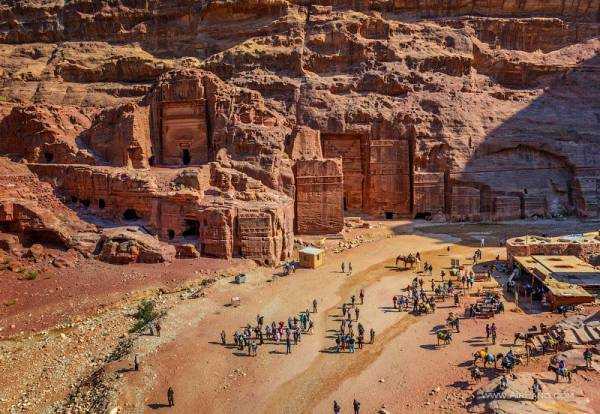
This "Street of Facades" is believed to have been built during the Assyrian era, with the builders borrowing many architectural features from the eastern invaders. The road leads us to a massive amphitheater, built, or rather, carved, directly into the rock. I couldn't count the number of seats; guidebooks indicate between 3,000 and 7,000. The theater was originally built by the Nabataeans for ritual purposes and later expanded by the Romans to accommodate grand performances that drew half the city.
The precise purpose of the rock structures is unknown. Many former tombs were later converted into dwellings and temples. The question remains: were all the structures tombs? Therefore, when describing Petra, I will use the established terminology, as is common in modern Jordan.

Several roads radiate from the Amphitheater, each leading to its own time. Turning right, you'll reach the impressive "Royal Tombs" complex. Heading west, we'll see the ruins of the Temple of Dushara, the supreme god of the Nabataeans. This is perhaps the only massive structure standing free from the cliff.
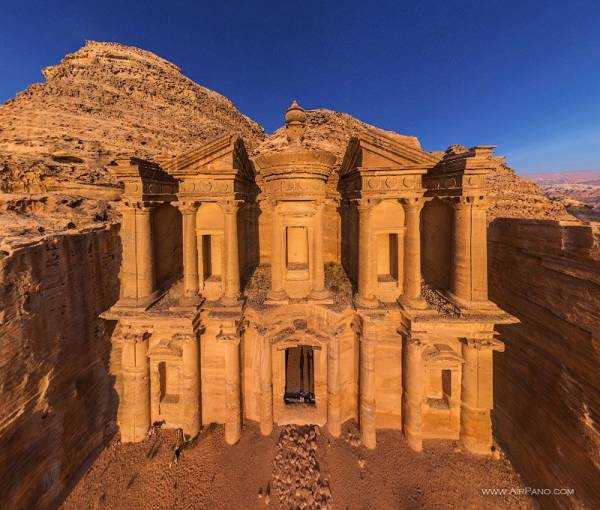
The trail then leads to a narrow gorge with a long (800 steps!) and steep staircase to the Ad-Deir Monastery, Petra's largest structure.
To climb up the gorge, we had to hire donkeys; however, a hardy traveler could easily make the journey on foot. Built in the style of the Treasury, but with less detailed ornamentation and devoid of statues, Ad-Deir Monastery is noticeably wider. It is known for certain that in Byzantine times it housed a Christian church, hence the name. You can climb the rocks to the very top, to the urn, to appreciate the scale of the Nabatean stonemasons' work and the magnificent view of the entire Valley of Moses. The only way from here is back down…
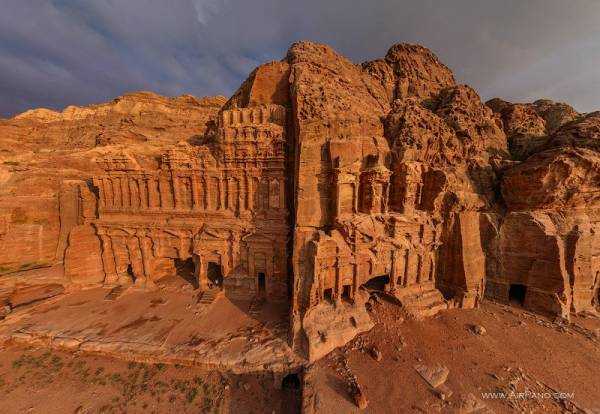
From a distance, beyond the Monastery, the Royal Tombs appear small against the backdrop of the Jebel Qubta rock from which they were carved. The furthest, dating to 126 CE, is the only tomb in Petra with an inscription identifying its intended recipient: Sextius Florentinus, the Roman governor of Arabia. If you move from it toward the Amphitheater along the Wall of the Kings, you can see the Palace Tomb, with its façade shaped like a Roman temple; the Corinthian Tomb, similar to the Treasury but heavily damaged by time and earthquakes; and the comparatively small Silk Tomb, whose walls are painted in every shade of yellow, red, and gray sandstone and appear to be covered with a shimmering silk shroud. The nearby Urn Tomb is no less tall than the Treasury or the Monastery. It is approached via a multi-story arched plinth, intertwining staircases, and a side colonnade. The room beyond the massive entrance, measuring 17 by 19 meters, is also striking, offering a cool, semi-dark retreat from the heat.
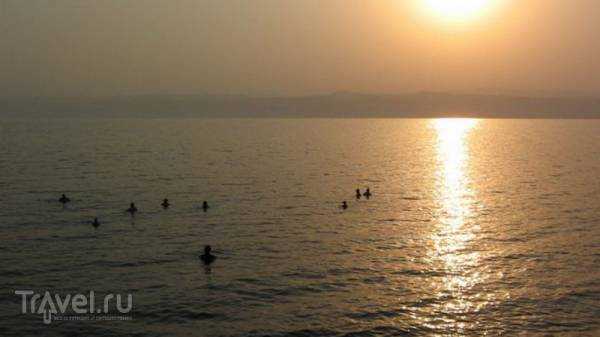
And my advice to those who read to the end: when you arrive in Jordan, you can also spend a day at the Dead Sea, admire the sunset in the Wadi Rum desert, relax for a couple of days at the Red Sea, but the remaining time should be devoted entirely to strolling around the city in the rocks.
Virtual tour
Spherical 360 video
For invaluable assistance in obtaining permission to shoot in Petra and moral support, we thank the wonderful photographer Ildara Yambikova.
For providing the AirPano team with the necessary documents, a warm welcome, and accommodation, we are grateful to:
— To the head of the Rossotrudnichestvo representative office — A.A. Dorofeev;
— Acting Head of the Rossotrudnichestvo Representative Office — V.I. Zaychikova;
— To the Head of the Information and Analytical Department of the Russian Center for Science and Culture — N.V. Sukhov.
Source: travel.ru