





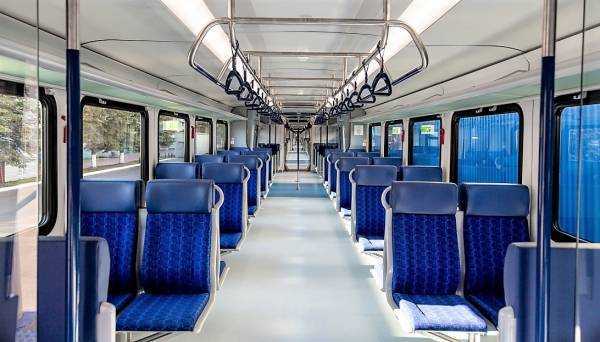

Moscow authorities have published the starting fares for the future MCD (Moscow Central Diameters) urban and commuter train lines. The new fares will significantly reduce travel costs for many residents of the Moscow region. Moreover, their introduction will significantly reduce the load on some radial metro lines, according to a Travel.ru correspondent.
The two main ideas behind the new fares are the introduction of free transfers to the metro and the Moscow Central Circle (MCC), and a single price to any point in Moscow. Together, these features dramatically reduce costs for most MCD passengers from the Moscow region. The second revolutionary effect of the new fares is to reduce the burden on commuter train-metro transfers on the outskirts of Moscow and evenly distribute passenger traffic across multiple transfer hubs.
Nowadays, the lion's share of passengers arriving from the Moscow region transfer from commuter trains to the metro at the first opportunity to save money. For example, a ticket from Podolsk to the nearest metro station (Tsaritsyno) currently costs 46 rubles, while a ticket to the next metro station in Tekstilshchiki costs 69 rubles. Those traveling to Kursky Station pay an exorbitant 115 rubles, while those traveling to Kalanchevskaya, Dmitrovskaya, or Rizhsky Stations pay 138 rubles. After that, they have to pay extra for the metro.
Due to these fares set by the commuter company Central Suburban Passenger Company (TsPPK), most passengers exit commuter trains at the nearest transfer station (in this case, Tsaritsyno), overloading this hub and trains on the Zamoskvoretskaya metro line. The new fare system solves this problem: a trip from Podolsk to any station in Moscow, including a subsequent free transfer to the metro, costs only 45 rubles. As a result, many passengers will not exit at Tsaritsyno to save money; instead, they will continue their journey by commuter train to more convenient points in the capital, and the Zamoskvoretskaya metro line will be somewhat relieved. Therefore, the benefits of these changes will be felt not only by residents of the Moscow region but also by Muscovites who use the metro.
Residents of stops near Moscow will see smaller, but still significant, savings. For example, a trip from Krasnogorsk to the nearest metro station in Tushino or to the transfer to the Moscow Central Circle in Streshnevo currently costs 23 rubles, 46 rubles to Dmitrovskaya, 69 rubles to Rizhsky Station, and 115 rubles to Tekstilshchiki. Under the new fare system, any such trip will cost 45 rubles with a free transfer to the metro or the Moscow Central Circle. As a result, many passengers will avoid getting off at Tushino and continue on the commuter train, and the western section of the Tagansko-Krasnopresnenskaya metro line will be somewhat less congested.
If a passenger travels on the MCD only within Moscow, the price is 38 rubles, including the transfer to the metro or MCC, as well as between them (within 90 minutes from the first entry to the last transfer). In effect, MCD lines within the capital will be treated as metro lines.
The first two MCD lines and their new fare system may be launched this winter. Line D-1 will run from Odintsovo via Belorussky and Savelovsky railway stations to Lobnya, while Line D-2 will run from Nakhabino via Rizhsky, Kalanchevskaya, and Kursky railway stations to Podolsk. These lines will be served by Ivolga commuter trains, which will operate alongside regular commuter trains on the Belorussky, Savelovsky, Rizhsky, and Kursky lines.
The new fares will be available not only to those living along MCD lines but also to passengers at more distant stations on the same routes (for example, Chekhov, Serpukhov, Volokolamsk, Dmitrov, and so on). For them, the standard fare of 45 rubles within the MCD zone will be supplemented by 23 rubles for each additional suburban zone.
Free transfers to the metro or the MCC ring will be valid for 90 minutes from the start of the entire journey. This will be available with the Moscow Troika card, which will be the primary means of payment on the new MCD lines. However, there are no free transfers to city or suburban buses, and taking a bus after a commuter train will invalidate your free metro access.
MCD fares can also be used for travel on regular commuter trains on the same routes. Conversely, passengers on the new MCD trains can use the standard, current Central Suburban Passenger Company (CPPC) fares if they are more cost-effective for specific journeys that don't require a transfer to the metro or the MCC.
Meanwhile, numerous fare issues remain unclear. In particular, the prices for monthly, annual, and other passes have not yet been finalized. The mechanism for applying fares if a trip from an outer suburb takes more than 90 minutes is unclear, including due to commuter train delays. It is also unclear whether all outer suburb stations near the Moscow region border will be equipped with Troika validators. Another question is whether this entire system will somehow be accessible for trips from outside the Moscow region, or whether passengers will have to exit along the road to validate their Troika at a station within the Moscow region. It is unclear whether there are any geographic restrictions on transfers between the MCD and the metro (for example, whether it is possible to travel on the MCD to Kalanchevskaya but enter the metro at Krasnye Vorota instead of Komsomolskaya). Many potential passengers have concerns about the layout of Ivolga trains, whose carriages have approximately half as many seats as regular commuter trains. Information about these and many other issues and problems is not yet available on the project's new website, mcd.mosmetro.ru, or anywhere else.
The launch of the MCD lines will likely be accompanied by some complications or surprises for passengers. This includes changes to established schedules, the addition of new stops (a number of which are currently under construction), increased travel times due to the new stops for a significant number of passengers, and the possible introduction of entry screening at new stations or platforms. Furthermore, information confusion is likely in the first weeks—however, much will depend on the ability of transport authorities to conduct a sensible and intensive information campaign in the months leading up to the launch.
If implemented correctly, the MCD project could radically improve the transportation situation in Moscow and its suburbs. At least three more MCD lines are planned for the next few years on the remaining commuter routes from Moscow (Leningradskoe, Kazanskoe, Kievskoe, Gorkyskoe, Yaroslavskoe, and Paveletskoe). Perhaps, in the future, it would make sense to transfer all commuter trains in the Moscow region under a single brand.
Source: travel.ru