





From Petropavlovsk-Kamchatsky to the village of Esso—the helicopter launch pad for the Tolbachik volcano—is about 500 kilometers of difficult asphalt and dirt road. I remember it only vaguely—due to the large time difference between Moscow and Kamchatka, I simply drifted off at times. When we finally reached the hotel, there was no time for sleep. Assembling and checking the equipment before the shoot took half the night. A short nap, a wake-up call in the early twilight, and our crew was already warming up the frozen Mi-8 and preparing it for takeoff. It was -19°C (-19°F) outside.
It's about a 30-minute flight from Esso to Tolbachik. Soon we see the front of a lava flow appearing through the windows… It's smoking, but there's no open flame—the forest isn't burning. We hover, open the hatches, and take our first shots. The volcano itself is hidden ahead by clouds and smoke. We decide to move up the lava flow. Finally, the first red lava flows appear below us! We slow the helicopter, shoot a few spherical shots, and are overwhelmed with emotion—we finally saw IT! Further upstream is impossible due to heavy cloud cover, and our crew begins searching for a landing site on the slope. Flying over the cooled lava flow, we see a crowd of tourists strolling along it. Some are wearing rather unusual gear—I saw a man in a silver suit very similar to the heat-resistant suits of firefighters. We spot a helicopter parked in a snowfield. We land higher up the slope, fairly close to the lava field, and head out to view the flow from the ground.

It's cold on the ground, and a strong wind isn't helping the feeling. We approach the flow; the rocks on the lava flow's side are barely warm to the touch. However, after walking about 50 meters, we begin to notice a red glow from the lava beneath some boulders. The temperature around us rises sharply. Everyone becomes extremely hot. After a few more minutes, it became clear that we couldn't safely approach the uncooked lava in this area. After climbing another hill, and smelling the burnt soles of our boots, we decided not to risk venturing into the thick of the heat.

We make camp on the slope, hoping for better weather. According to the pilots, the clouds usually cleared by evening. But the weather only worsens with time. The clouds thicken, the wind picks up. Taking off from a radio-controlled helicopter in such conditions would be pointless, ruining the equipment. We decide to make a test flight toward the lava, and then try again to find a landing site closer to the active cone of the volcano.

We take off. We begin to climb through some kind of fog or smoke, and suddenly a veritable river of fire appears before us! Dima and I realize that everything we've filmed up to this point pales in comparison to this new image. We open the hatches and windows and begin filming. We change positions and altitude. We ask the captain to descend lower, above the center of the lava flow. The cabin becomes incredibly hot.
I have to give credit to our crew, especially their commander, Dmitry. At times, we hovered very low over the lava. The helicopter was tossed about like a twig by the rising currents of hot air, but Dmitry kept it firmly anchored to the chosen point in space, like an invisible anchor. When I peered out the hatches during filming, it felt like I was sticking my head in a red-hot oven. Everyone was sweating from the unbearable heat and tension.
As a result of our work, The Weather Channel created a short video.
But as much as we wanted to, we were unable to reach the active cone of the volcano that day. The clouds on the slopes had not cleared by evening. Our helicopter landed near Sergei Gorshkov's camp. From this vantage point, there was a good view of the red-hot lava flow, and while waiting for the evening light, we spent about an hour, raptly observing the unstoppable force of nature. Imagine standing next to a mountain of rocks; this mountain is 5 to 10 meters high, several hundred meters wide, and tens of kilometers long. And this entire mass is moving right before your eyes—slowly, but quite noticeably, emitting a loud rustling sound. A sense of unreality overwhelms you. The mind refuses to believe that such a thing is actually happening...
At sunset, the clouds turned an unreal purple, and we quickly took off in the Mi-8, capturing one of the most beautiful panoramas of our tour over the lava flow. The sun set behind the horizon, and in the evening twilight, we returned to our base in Esso.
The next morning, we decided to take off before dawn, but all plans were thrown into disarray by a malfunctioning Mi-8 cabin heater. It had been working intermittently the previous evening, but the airfield mechanics managed to get it working again. Unfortunately, the heater froze again that morning and completely stopped providing heat to the cabin. It was -25°C outside, and while the mechanics were unsuccessfully trying to revive the heater, we consulted with the captain about whether or not to fly without it. Dmitry said yes, but we'd all be thoroughly frozen on the mountain. The decision was ours. After a brief discussion, we decided to take off—we might not have another chance to catch good weather.
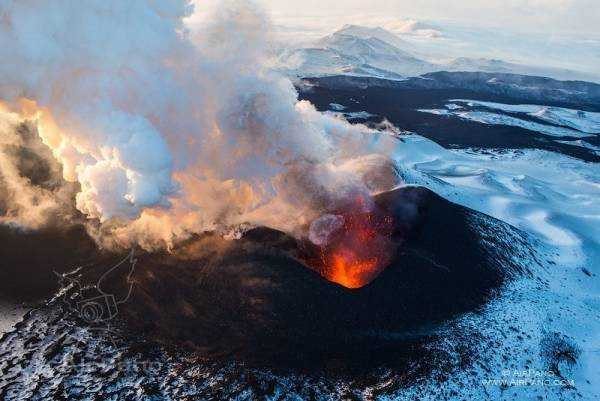
As we approach Tolbachik, we realize we're incredibly lucky! The slopes are virtually cloudless, with visibility reaching to the horizon. The plume of smoke from the active cone is illuminated by the rays of the rising sun. We set course for the cone! We fly around it—and there it is! Finally, from quite close, we see the lava gushing inside the cone. A fantastic sight! Unforgettable! We shoot the spheres, and the helicopter lands about a kilometer from the cone.
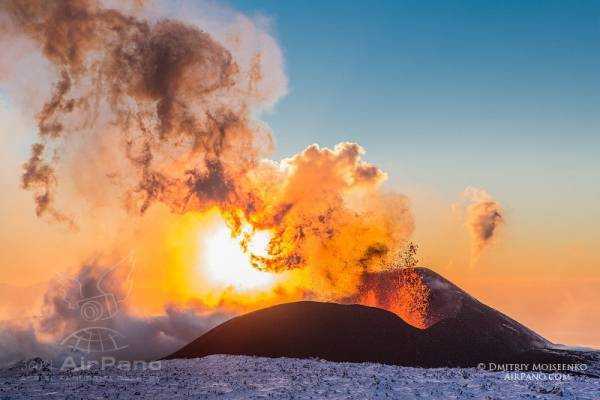
We go out to explore. It's getting even colder outside, thanks to a strong wind (10-15 m/s). We reach an old lava flow. It's scary to go any further. The ground underfoot is hot. It only looks cold in the photos because there's snow in places. In reality, if you scrape away the top layer a little, you can warm up frozen camera batteries, but if you dig a little further, the soles of your boots start to melt. Cracks are all around, and steam and gas are pouring out of the ground. Directly in front of us is a cone, inside which explosions occur every few seconds, sending streams of lava up to 200 meters high. There's a loud roar. The spectacle is mesmerizing, but we need to get to work, so I return to the Mi-8 for the radio-controlled helicopter.

I put on my warmest gear, slip on snowmobile gloves, and head to our group. A ski mask covers my face to protect me from the wind. I crawl out onto the snow. It feels like Neil Armstrong taking his first steps on the moon.
Dima Moiseenko and I are preparing the craft for launch. We don't know what will come of it; the conditions are beyond the capabilities of our equipment. The lowest temperature I've flown in up to this point was -15°C, but there was no wind. Now we're at an altitude of about 1,500 meters, the temperature is -31°C, and there's a strong wind blowing…
We check everything several times. The camera works, the video transmitter works, I start the engines – they don't start: they seem to have frozen. I restart the device several times – the engines still don't work. It's impossible to fly!
It's a shame, but not scary: we always carry a spare helicopter for just such occasions. I leave Dima to photograph the cone while I head to the Mi-8 to assemble the second model. It's -25°C in the cabin, and all the water bottles are frozen solid, but somehow I don't feel too cold. About half an hour later, the second model is assembled. I head back to our group standing on the lava field.
We repeat all the pre-flight check procedures. I start the engines – they still don't start! I start them again – they start! The machine is unstable, but I risk letting it fly on its own – and there it is, in the air, gaining altitude. We take off and begin filming the sphere, while Dima counts the shots and monitors the flight time. At times, the helicopter is thrown dangerously by gusts of wind, but I manage to keep it roughly in one spot. Finally, the filming is finished, and I lower the helicopter, catching it with my hand. My legs and arms are shaking slightly from the adrenaline rush.
Dima and I are reviewing the footage; it feels like we're standing far away. We decide to approach the cone closer. We carefully walk along the edge of the lava field. It's scary to go too far in, there are cracks all around. Finally, the voice of reason tells us it's time to stop. Let the equipment do the work from now on. We prepare for takeoff again, take off, and film the cone from several angles. The helicopter returns, we review the footage—now the footage looks good. Dima says, "Let's risk it and fly right up to the cone? We already have the footage, what if we get lucky again?" We change the flash drive in the camera and send our helicopter flying. I point it toward the cone, and then something irreparable happens—the machine plummets, crashing into the lava field. Most likely, the battery couldn't withstand the cold, or perhaps one of the motor controllers failed. There was no time to sort it out - forgetting about caution, we ran to save the remains of the equipment.

Oddly enough, I wasn't too upset after this incident—apparently the adrenaline hadn't fully worn off yet. We had to attempt takeoff in impossible conditions, and we succeeded! Yes, the apparatus crashed, but it managed to capture several unique spheres from a much closer distance than we could have from a large helicopter.
Having disassembled and packed the models, we wait for the evening light. With about forty minutes left until sunset, the Mi-8 crew and I head out to the lava field to photograph the volcano's gushing cone. It seems the lava activity has increased significantly by evening. Despite the bitter cold and fierce wind, the spectacle is mesmerizing, and the time remaining until sunset flies by. With great effort, we tear ourselves away from our contemplation of the volcano and run to the helicopter.
We launch, take off, open the hatches with now-familiar movements, and begin work. In those last half hour, the volcano, as if deciding to thank us for our patience and endurance, begins to erupt in double fountains of lava reaching many meters into the air. It was one of the most beautiful and memorable moments of the flight.
It was already deep dusk when we returned to the base in Esso. Tired, cold, but very happy that we finally made it! We photographed our first active volcano!
In conclusion, I would like to warmly thank those people without whom this trip would most likely not have taken place, or its results would not have been so impressive:
The crew of the Mi-8 of Kamchatka Airlines and especially its commander, Dmitry Zadirey.
Photographer Denis Budkov for the photographs provided.
Photographer Sergei Gorshkov.
Volcanologists - Olga Girina and Dmitry Melnikov. They compiled detailed descriptions of the objects you can see in the panoramas.
And also to all the caring guys First Kamchatka Forum, who helped us with advice and contacts.
Virtual tour
Spherical 360 video
We would also like to offer you some background information about the Tolbachik volcano.
Tolbachik Volcano (active Plosky Tolbachik (3085 m) and extinct Ostry Tolbachik (3682 m) is the largest volcanic center in the southwestern sector of the Klyuchevskaya group of volcanoes.
About 10 thousand years ago, a caldera (crater) with a diameter of about 3 km formed on the summit of Plosky Tolbachik, at the same time as which regional zones of cinder cones formed to the northeast and southwest of the volcano, similar to the rifts of Hawaiian volcanoes.
The southern zone extends 45-50 km to Nikolka Volcano and is called the Tolbachinsky Dol. Along the axial part of the Dol, up to 80% of all activity centers are concentrated in a narrow (3-4 km) band, in the form of numerous fissures and chains of cinder cones that form a volcanic ridge.
There are two known eruptions in Tolbachinsky Dol. The first occurred in May 1941. Within a week, a cinder cone approximately 200 m high formed, 0.07 km3 of pyroclastic material (volcanic material - ash, scoria) was ejected, the lava flow length reached 5 km, and the lava volume was 0.03 km3. The second eruption lasted from July 1975 to December 1976. For the first time in the world, it was predicted by P.I. Tokarev a week before the event. This allowed volcanologists to observe the onset of this fissure eruption in detail. Over the course of 1.5 years, 8 cinder cones up to 300 m high formed, approximately 1.0 km3 of pyroclastic material was ejected, the lava flows length reached 9.5 km, and the lava volume was 1.2 km3.
A new fissure eruption in Tolbachinsky Dol began on November 27, 2012, and continues to this day. From November 27 to December 5, the area of lava flows was approximately 20 km², and the volume of erupted material reached 1.0 km³ over 24 days and continues to increase. Thus, the 2012 eruption can already be considered the most powerful eruption in Tolbachinsky Dol.
The description was compiled by O.A. Girina, PhD in Geology and Mineralogy, leading researcher at the Institute of Geochemistry and Soil Science, Far Eastern Branch of the Russian Academy of Sciences.
Source: travel.ru