





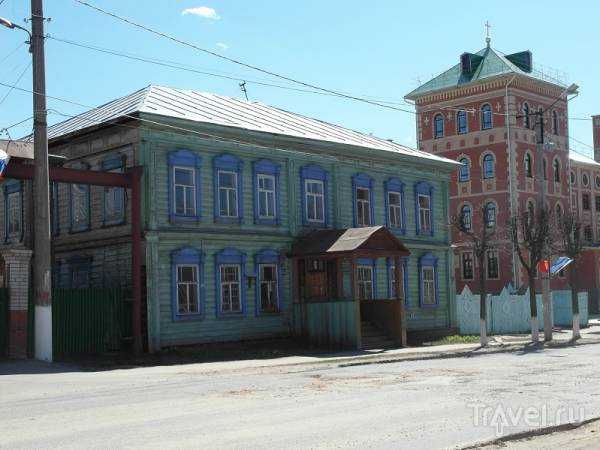
The title of this post is certainly too grandiose. There's very little left of the Russian Empire in today's Yoshkar-Ola. There are about twenty buildings of any interest. I photographed about half of them—most of old Yoshkar-Ola is in a worse state than expected. It was only when I got home, studying the material, that I realized that the crumbling, dusty buildings I'd passed by without even looking were the local old town.
As an addition, there are some elements of the city that, at least simply, send us back to the pre-revolutionary past: a magnificent mineral lake in the Mari forests and the famous Sheremetyev Palace in Yurino.
The photo shows a former women's convent school from the late 19th century, belonging to the Mother of God-Sergius Monastery. It is considered the first charitable educational institution for Mari girls. With the abolition of the convent, the school ceased operations. Under the Soviets, it housed, at various times, a technical school, a music school, and an art college. Today, it houses an Orthodox center.
To the right of the monastery school, a section of the newly constructed brick Orthodox center can be seen. I repeat, the new center was built here for a reason, specifically on the site of the former monastery, of which this school is a fragment.

To be honest, Yoshkar-Ola never had a luxurious old town. Its role as a military town in the remote forests, far from any roads, left the city with no luxurious merchant mansions or noble palaces. Because there were very few of either. However, there were still some attractive architectural monuments. Some of them have already burned down, others were demolished. Some of the surviving buildings, officially designated "architectural monuments," are now in a deplorable state, completely unattractive.
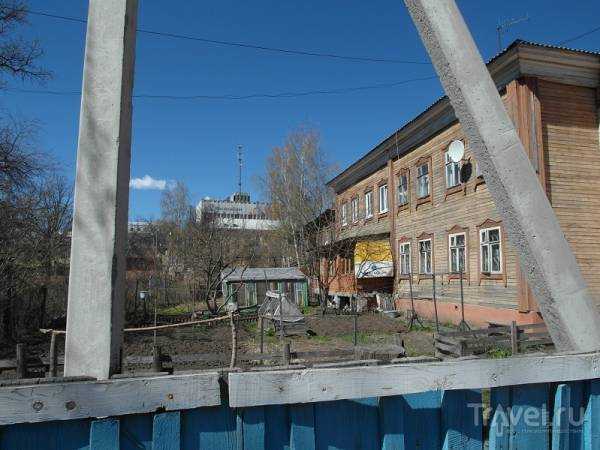
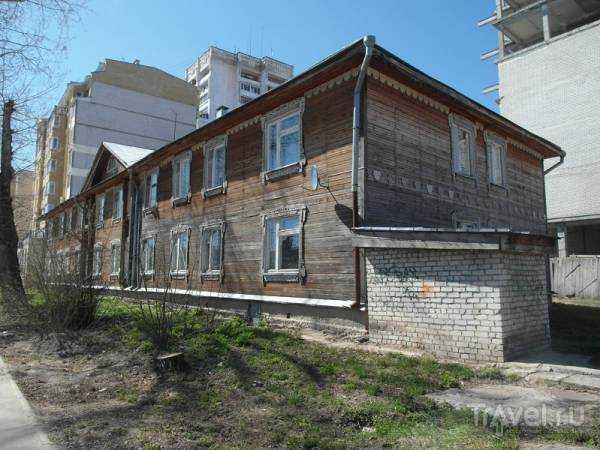
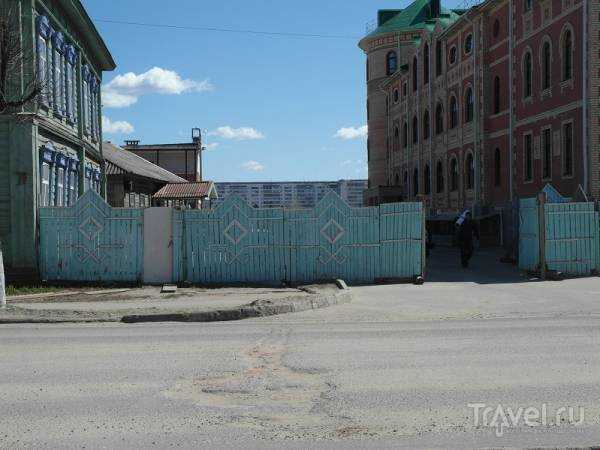
The photo behind the blue fence shows the former residential building of the same Bogoroditse-Sergius Monastery, dating back to the late 19th century, across the street from the monastery school. It looks like a barracks:
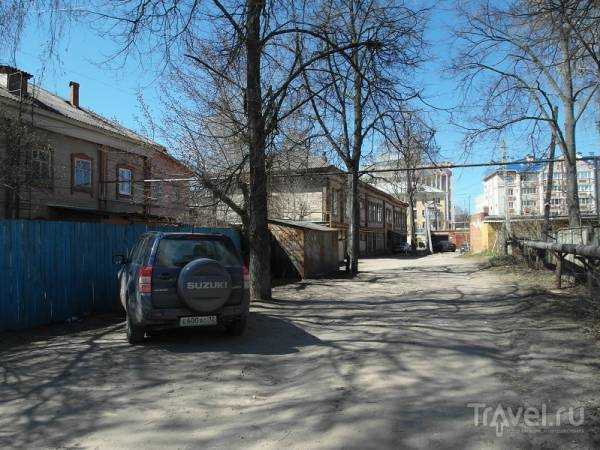
In the courtyard of a residential building of a 19th-century monastery, there is a vegetable garden, in the very center of Yoshkar-Ola:
The Cathedral of the Ascension of Our Lord, built in 1756, offers good views from the newly constructed part of the city. The church was closed in 1937 and became a brewery. Before World War II, the old bell tower with the city clock was demolished. What we see in the photo is the restored version from 2009, which differs slightly from the original. It is the oldest surviving church in the city and one of the oldest buildings.
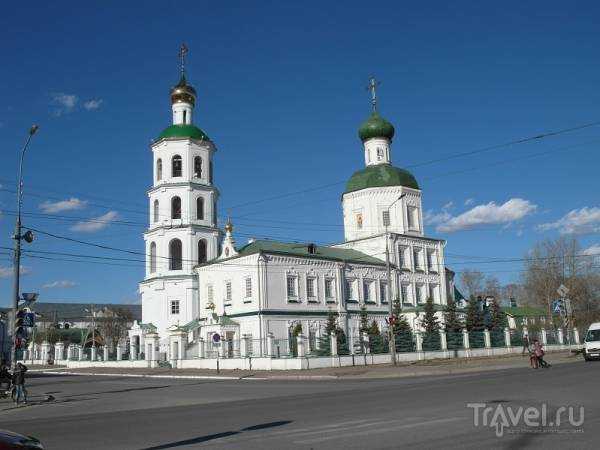
Let's look at the cathedral from a different perspective. Firstly, you can see that the new center of Yoshkar-Ola is adjacent to it. Secondly, on the left in the frame, in front of the cathedral, we see the merchant Pchelin's house—the oldest civil structure in the city. The Pchelins were the most famous and wealthy dynasty of Tsarevokokshaysk merchants. It was with Pchelin's funds that the Ascension Cathedral was built next to his estate. For some reason, I didn't photograph it separately. Incidentally, you can barely see it in the previous photo, on the left.
There is a legend surrounding this house that several underground passages lead to it from different sides of the city.

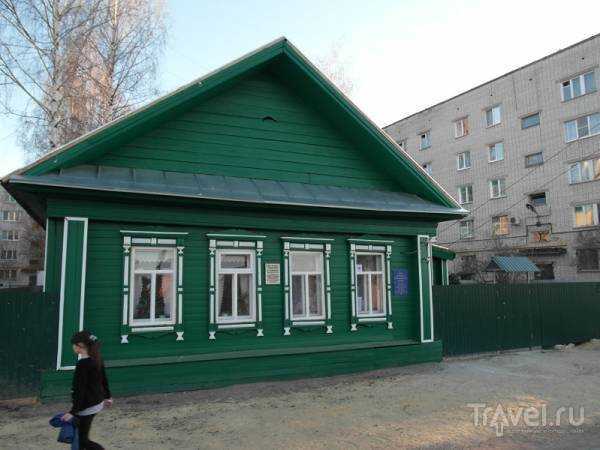
The memorial house-museum of Klyuchnikov-Palantay, composer and founder of professional Mari music. This house, where the composer spent his final years in the 1920s, is located among residential high-rises, slightly away from the city center. Its historic status likely accounts for its survival. Moreover, judging by photos online, it has been renovated in recent years:
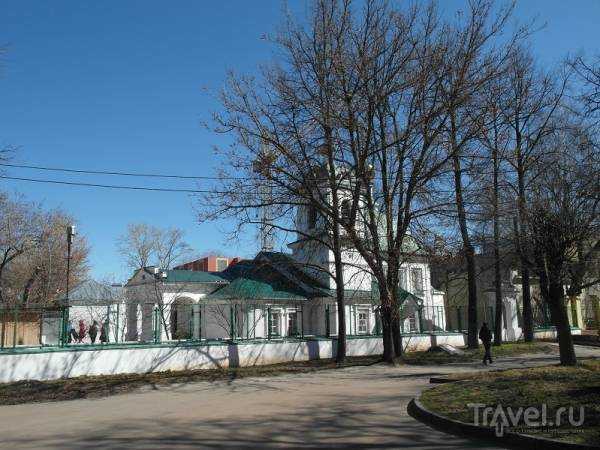
The second oldest church in Yoshkar-Ola—the Tikhvin Icon of the Mother of God—was built in 1774 in the city cemetery, funded by merchant S. Vishnyakov. Today, the cemetery's site is occupied by the Central Park of Culture and Leisure (see part 2). The church is located in one of its corners:
An outbuilding on the estate of Tsarevokokshaysk timber merchant Sokolov, also known as the "zemstvo police chief's building." In the 1990s, it was in disrepair and restored in the 2000s. Due to its somewhat sloppy reconstruction, it looks like one of the many new buildings in Yoshkar-Ola. Souvenirs are sold inside:

One of Yoshkar-Ola's most striking old buildings, the Korepov merchants' house, is still in decent condition, despite being surrounded by the new Yoshkar-Ola on all sides:
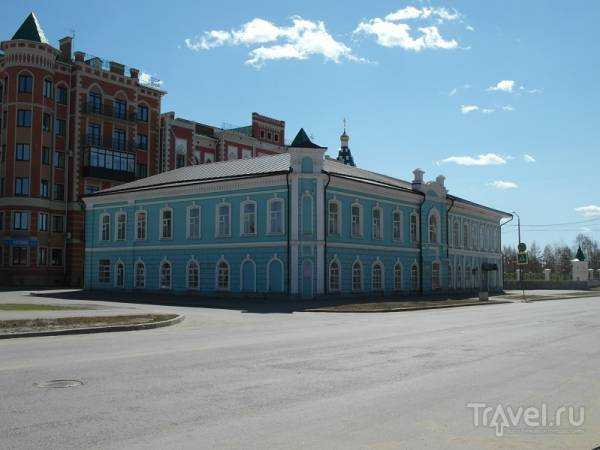
The Bulygin merchant's house, built in 1835. The Bulygins, as owners of a distillery, opened a beer hall on the ground floor. Apartments were rented out on the second floor. In 1918, the building was nationalized and became the headquarters of the Military Revolutionary Council. In 1937, mass executions took place in the basement of the building, which now belonged to the NKVD. Today, it houses the Gulag Museum.
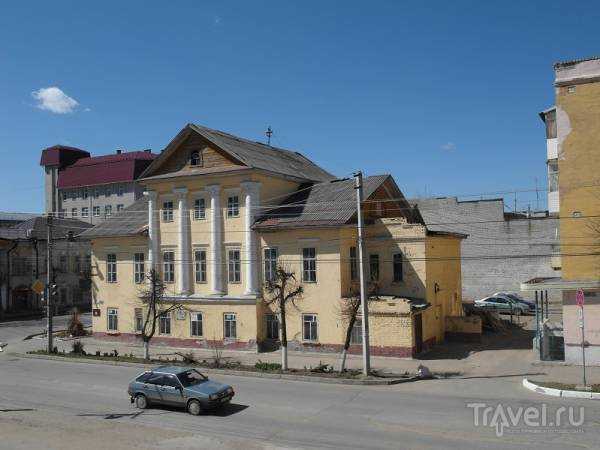
Across the street from Bulygin's house is the home of another merchant, Naumov, dating from the late 19th century. This was once the Market Square, onto which both merchants' windows overlooked.
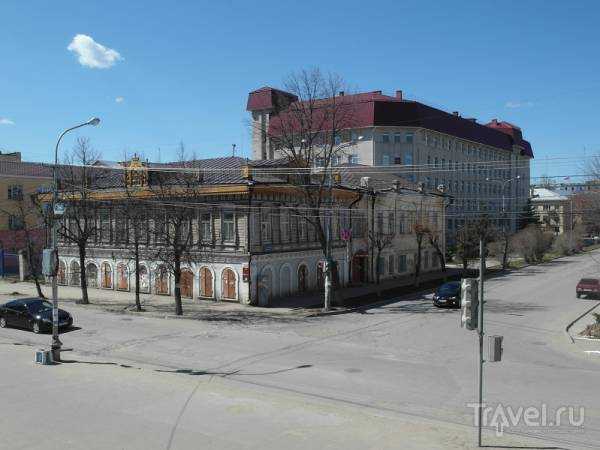
A house built in the 1930s for the teachers of the Forestry Institute on the site of the burned-down home of timber merchant Selivanov. Originally, it looked quite different, made of logs and shaped like the letter H. Today, it looks more like a barracks:
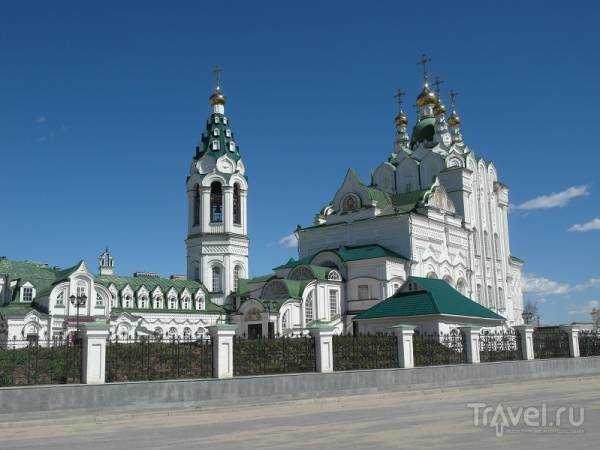
Trinity Church, located opposite the newly built Dutch houses, is ostensibly a new building, but it was built on the site of the oldest church in Tsarevokokshaysk. Moreover, at the time of its construction, some ruins of the old Trinity Church remained, so it's a stretch to call it a reconstruction. However, the church's form and decoration are completely new and bear little relation to the old church.
That's pretty much it for the interesting buildings of old Yoshkar-Ola. I've got 13 photos. There should have been about the same number of architectural monuments, half of which also resemble old barracks, but, as I said, they're not particularly eye-catching, so I simply didn't think to photograph them. Now we can look at the buildings in Yoshkar-Ola that at least somehow evoke the past.
A monument to Ivan Andreevich Nogotkov-Obolensky stands in the square opposite the city and republic government building, which is home to perhaps Yoshkar-Ola's finest new building—an art gallery shaped like a Venetian palace. In fact, the square itself bears his name. He was a Russian military commander sent to suppress the Cheremis (Mari) rebellion. During this process, he arrived in the newly formed Tsarevokokshaysk and became its first voivode, for which he is sometimes called the city's founder. According to some reports, Nogotkov-Obolensky went missing shortly thereafter.

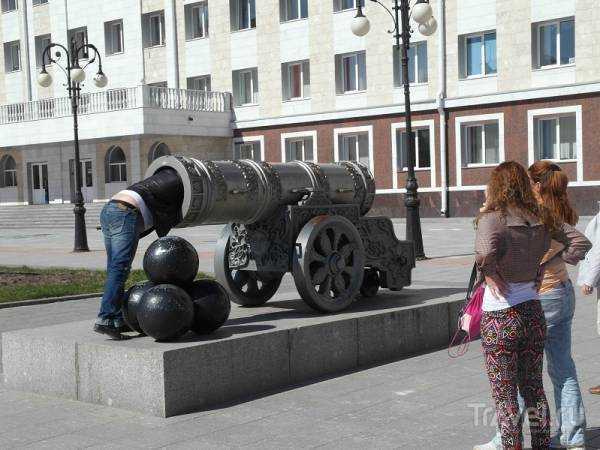
A replica of the Tsar Cannon has been installed next to Nogotkov-Obolensky.
On the Malaya Kokshaga embankment, against the backdrop of Soviet Yoshkar-Ola, a monument to A.S. Pushkin and Eugene Onegin was erected in 2011. A rather original idea, it must be said:

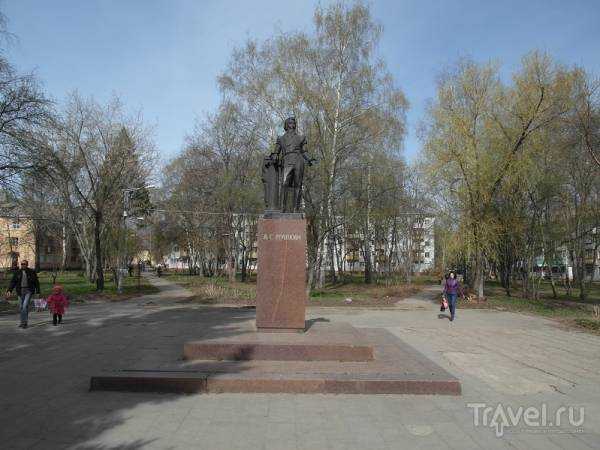
It's quite amusing that the monument to Pushkin and Onegin is located where Pushkin Street meets the river and ends. The opposite end of the street, where it begins, is bordered by a park where there's also a monument to Pushkin, this time a Soviet one from the 1980s:
In Yoshkar-Ola, we encountered some very interesting people, unusual for residents of large Russian cities. Besides the Mari themselves, who look very different from other Russian peoples, and the 90s-style market women I wrote about in Part II, we also saw, for example, a short, bearded old man. His beard resembled that of peasants in pre-Petrine times. He was dressed in a shabby cloak and hat. He seemed to come from another world...
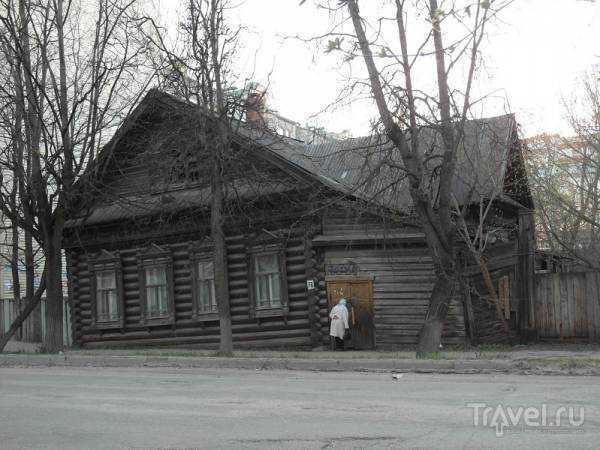
One of the abandoned old houses in the center. I wonder what caught the woman's attention?
While the newly built Yoshkar-Ola center is still controversial, although in my opinion, it's a definite plus for the city's tourism, the residents of Mari El are certainly lucky to have the Sernur Cheese Factory in their republic. This company produces truly amazing dairy products, including one of their signature products—goat's milk products. While some of their products are quite common in Moscow, the full range of dairy delights can only be experienced in Yoshkar-Ola. You won't even be able to stock up on them—they only last for three days, tops.
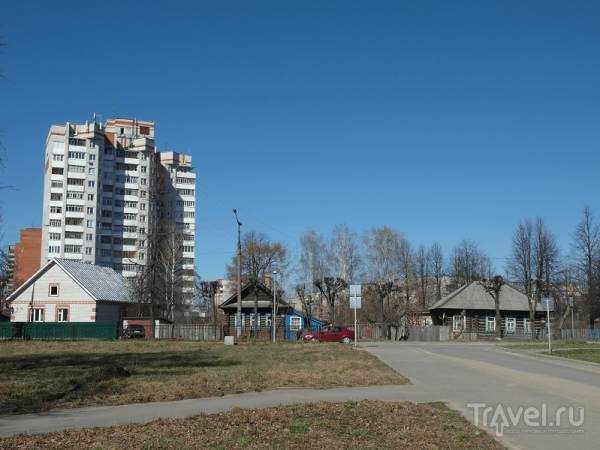
At the junction of old and Soviet Yoshkar-Ola:
The level of housing and utilities services in Yoshkar-Ola varies widely, from immaculately maintained courtyards to horribly filthy and littered ones. Perhaps different management and maintenance companies maintain different courtyards, resulting in different conditions?

Another detail that transported us back to either the '90s or '80s was a diner on one of the city's secondary streets. We stopped in out of curiosity—drunk, flushed men were standing at high, round tables, the menu offered a couple of kinds of cheap vodka and inedible-looking pirozhki. Apparently, that's what people eat here...
Fence with national pattern:
Source: travel.ru