

What clothes should I bring to India?

India is a fairly conservative country, so it's best to dress modestly, especially if you're traveling through remote villages and visiting temples. Women should avoid mini-shorts and skirts, excessively exposed shoulders, and low-cut T-shirts.
Men should avoid overly revealing T-shirts and shorts.
In short, the most appropriate clothing for hot Indian weather is loose, figure-hugging, and made of lightweight fabrics (cotton, linen)—that's what the locals wear. So, you'll probably end up shopping sooner or later. So, what traditional outfits can you buy?
What do men wear in India?
With men, it's simple. Most wear either "European" clothing: shirts, T-shirts, or loose, long tunics (called kurtas)—all paired with jeans or trousers.
But sometimes you can find a more casual option: instead of pants, the legs are wrapped in a dhoti—an elongated version of the loincloth. Strictly speaking, a dhoti is a long piece of fabric wrapped around the hips, with one end passed between the legs.

The length of the dhoti is a sign of caste, so somewhere at a construction site you can see short dhotis - almost loincloths.

Indian women's attire
There are three main types of outfits for women.
Shalwar kameez - a suit consisting of a tunic and trousers.

The third detail of this outfit is a long dupatta scarf that matches the top and trousers; it is usually sold in a set.

The overtunic comes in various styles: short, barely covering the hips, or long, almost to the ground, narrow and straight, or flared, resembling a dress. Pants are made either narrow and straight (sometimes too tight, resembling leggings) or wide, harem pants.

This is perhaps the most comfortable clothing for traveling in India. If there's one thing worth buying in this country, it's the shalwar kameez.

Lehenga-choliA lehnga choli is a short, tight-fitting blouse with a long, full skirt, revealing the midriff. However, modern blouses can be long, sleeveless, and have straps. This outfit is much less common on the streets: brightly colored skirts embellished with lurex, sequins, "zirkals," and even precious stones and gold chains are usually worn for holidays and celebrations, although in some states, they are also worn as everyday wear in hot weather.
For tourism purposes, a lehenga-choli is not the most comfortable clothing: a long skirt made of brocade or chiffon, satin or velvet is rather impractical, and a bare midriff on the street may be frowned upon in puritanical villages.

Sari The sari is the most famous Indian garment. It's a long piece of cloth (usually 5-9 meters) that Indian women expertly wrap around themselves. They first wrap it around their waist, draping it in folds, and then drape the long end over their shoulder. There are many ways to wear a sari. A short, form-fitting top with a wide neckline or a blouse and petticoat are usually worn underneath.
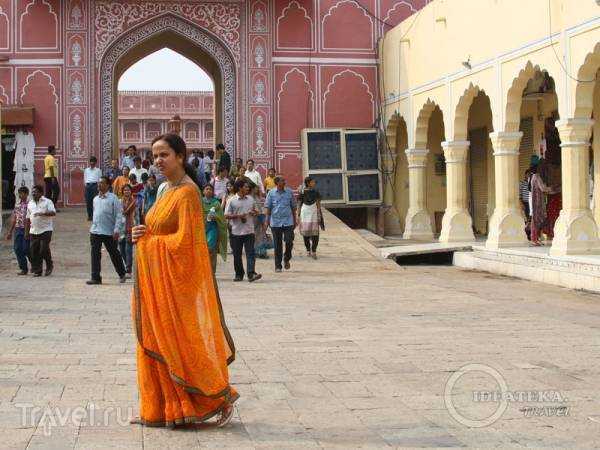
Usually, when tourists come to India for the first time, they rush out to buy saris. Then, disappointment sets in.
- Firstly, learning how to properly wrap several meters of fabric around yourself is quite difficult.
- Secondly, this outfit suits the fragile and petite inhabitants of Hindustan and significantly plumps European women.
- And finally, thirdly, if you haven’t worn a sari since childhood, it will be very uncomfortable for you to walk in it, ride in public transport, and perform the most ordinary activities.
So, the long scrap then sits in the closet for years, or at best, is used to sew something. So, before you succumb to the charm of a salesperson juggling fantastic fabric, think about what you'll do with it.

And if you still decide to experiment with a sari, in this video It shows how to wrap yourself in it correctly.
In some parts of the country, you'll find other clothing. It's cold in the Himalayas in winter, so they wear warm sundresses like these. But that's only at first glance.

In fact, it is a large blanket that is wrapped around the body in a whimsical way.

Want to try it? Watch it video instructions.
Source: travel.ru