

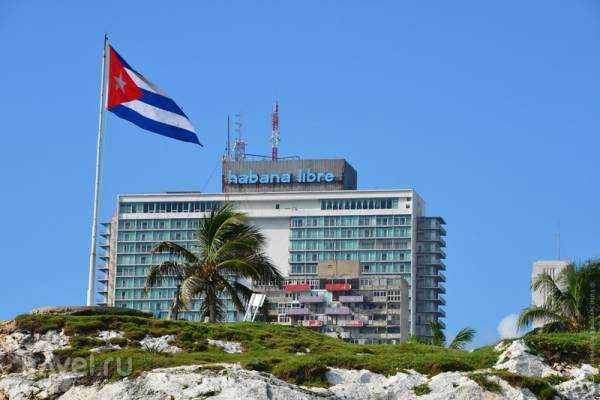

From the very beginning, the Cuban revolution was a national movement, and only later, with the support of the USSR, did it evolve into an attempt to build socialism in a single country. Fidel even vowed to shave his beard as soon as communism was achieved. He wore it until his death… However, "we have socialism," a taxi driver proudly informed me as he got chatty.
After the collapse of the socialist bloc, Cuba didn't abandon its ideals, maintaining its status as the "Island of Freedom." I didn't see any profound isolation there. The taxi driver I mentioned told me that with Raúl Castro's arrival, the economic situation in Cuba began to noticeably improve. It became possible to buy and sell real estate, for example, and loyal comrades were able to travel abroad freely (in his words). Opportunities for starting a business, even in its infancy (whatever that means...), improved. The policy toward dissent softened, and many political prisoners were released in 2006. And the leader himself, Raúl Castro, is noticeably different in appearance from his older brother: He shaves his beard and wears a suit (not a tunic). Well, we'll see how successful the new leader is in creating a bright or happy future; history will judge.

In the very center of Havana, in Revolution Square, rises a colossal obelisk, stele, and tower, over 130 meters high. At the base of the tower stands a monument to José Martí, the founder of the Cuban revolutionary movement, who first proclaimed the ideals of freedom and independence for Cuba. This was long before Che Guevara and the Castro brothers. He is the Cuban Lenin; streets, avenues, public facilities, and other important institutions in Cuba are named in his honor.

Here in the square there are huge portraits of national heroes and ideologists of the Revolution in Cuba: Ernesto Che Guevara on the building of the Ministry of Internal Affairs,

and a portrait of the revolutionary and Fidel's comrade, Camilo Cienfuegos, on the Ministry of Communications building. At first, I mistook him for Fidel himself...

It must be said that Revolution Square is the center of Cuba's most important government buildings. For example, the Ministry of Defense building,

And this ideological center—the Library named after whom? Of course, José Martí.

From here, as from a podium, every year on May 1st, Fidel Castro delivered his famous speeches to the people while he was at the helm.

Where is the Leader looking?

Surprisingly, I didn't see any portraits of Fidel or Raúl, party slogans, or other paraphernalia anywhere in Cuba. In that sense, Vietnam, for example, looks much more socialist than Cuba.
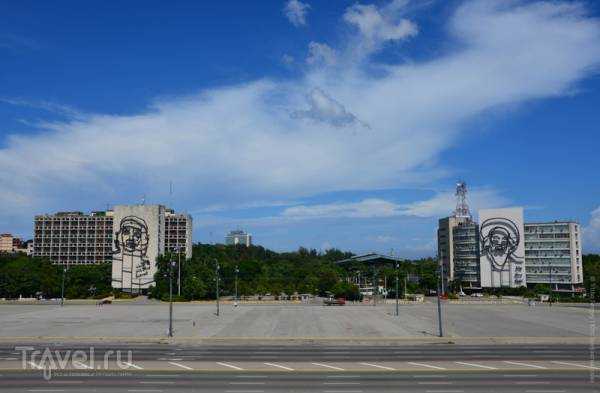
Behind the memorial stands the building of the Central Committee of the Communist Party of Cuba. It's deserted here on a Sunday, with only soldiers keeping watch at the edges…

At the top of the tower is an observation deck, the highest in Cuba. They say you can climb to the top, but unfortunately, on the day I visited, the top deck was closed.

But even from the lower platform, there is a good view of the Cuban capital, if you look closely, of course.

However, it is hot. The few tourists take quick photos against the backdrop of revolutionary buildings,
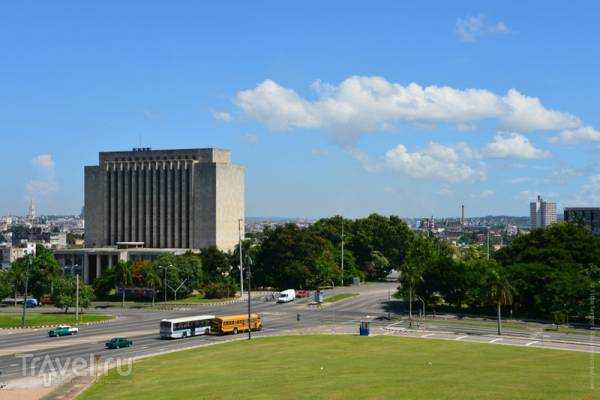
and they hurry to where the sea is, where it’s cool…

And I will not be an exception to the rule, and I will go in this direction.

Where? Let it be a little secret...
Source: travel.ru