





I traveled to Western Turkey in November 2013.
Today I'll tell you about the "cotton castle," which is what Pamukkale is translated from Turkish. It's located near the city of Denizli, where there's an airport. But my friend and I weren't looking for the easy way out! We rented a car in Izmir and set off to conquer Ephesus, Kusadasi, and Pamukkale.
It was 21°C outside in late autumn, and the water temperature ranged from 35 to 100°C! It was cool in the city itself, but humid and even hot near the water.

We arrived in town in the evening, and a guy stopped us on the road and offered us his hotel. It was the off-season, so for 20 euros we got a luxurious double room with breakfast! Although the resort is open 24 hours a day, we decided to go in the morning and just stroll around in the evening. From a distance, it looked like snow on the mountain. But the palm trees didn't look right for winter.

The main tourist flow has left, so there's no one to give pomegranate juice to. I don't even want to eat it!

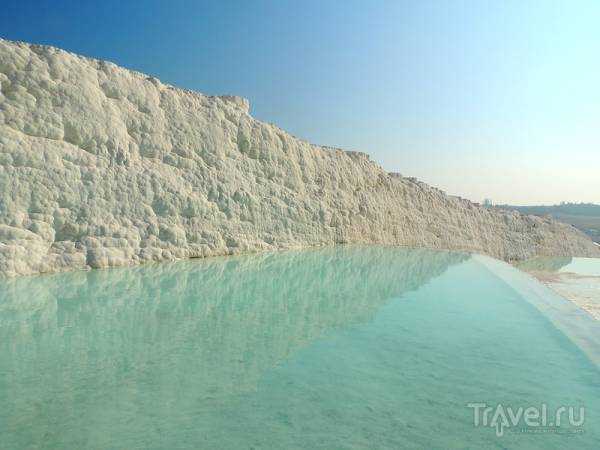
This beauty, listed as a UNESCO World Heritage Site back in 1988, awaited us in the morning. Pamukkale boasts 17 geothermal springs, which look like terraced pools formed from travertine. They have a whimsical shape, and the water flows down from the mountains. And we had to climb up there…

On the other side of the mountain they were flying paragliders

We paid for the tickets and then... off to the bench. We had to take off our shoes and carry them in our hands. You can only walk barefoot, otherwise you'll get kicked out, fined, or just scolded :))

To be honest, it was cold to step onto the white surface. We looked for water; at least it warmed us. Travertines are limestone walls formed by water itself and calcium-rich salt.


In 2007, Pamukkale was closed for renovations, and I think they banned swimming anywhere. But I didn't see anyone chasing people away. People swam almost anywhere there was water depth (maximum 1 meter). I was pining for my swimsuit, which I'd left at the hotel.

Someone said the water tasted like Narzan. But I didn't dare try it.

According to legend, the white cliffs were formed during the time when titans lived here, harvesting cotton and drying it in the sun. Left unattended, the cotton hardened and turned into snow-white mountains.

The hot spring waters, rich in calcium carbonate, hiss as they burst from the ground. The calcium contained in the thermal water solidified in the air, forming travertine cascades, terraces, and pools resembling inverted bowls.

Gutters are made or built to drain water

Andrei Mikhalkov-Konchalovsky filmed part of "The Odyssey" (1997) in Pamukkale.

These places also served as a filming location for Ghost Rider 2 (2012).

Space!

There were funny signs up there. "Be careful, it's slippery!" They took our shoes off themselves...

From a distance these reservoirs look like this

Cleopatra's pool still stands at the top of the mountain. The queen took great care of her beauty and often visited. Incidentally, tickets are discounted in winter (50%). Nearby are the ruins of Hierapolis, as I understand it. In 1354, a powerful Thracian earthquake completely destroyed the city.

Besides the ruins, there's a beautiful park and a bench by the pool on the cliff. While I was warming my feet, my eyes were enjoying the view of the city. Due to the evaporation, the city is almost invisible.

The same place, but from the other side

Source: travel.ru