






Even though it had only been a short time since we left the mainland, some changes had already taken place on Ongachan. For example, a small but very cozy bathhouse had appeared next to the river, and we all enjoyed a steam bath that same day. It had been put together by the workers who had stayed behind to look after the base.

Moreover, new faces appeared here—a small group of scientists from the Institute of Water and Environmental Problems (Khabarovsk), led by Olga Vilenovna Shpak. They were heading from Maly Shantar to Chumikan, but since visibility was extremely low due to the fog, they decided to wait out the storm here. Meanwhile, they observed bears, whales, and other animals.

In the photo on the left, PhD Sergei Alekseevich Kolchin and our Valera are watching the bears.


As you can see, the clubfoot cubs haven't gone anywhere. On the contrary, there are even more of them. For example, a mother bear with cubs appeared, whom we immediately christened Mashka. Mashka had three cubs. One of them was almost always by their mother's side, another was always lagging behind and would start howling loudly, and the third, like a meteor, darted tirelessly between them.


The family paid almost no attention to people, but behaved extremely cautiously around other members of their species. This is understandable, as adult males can pose a real threat to cubs.


These animals are very good swimmers. We've often witnessed them swam quite far out to sea in search of fish, splashing around in the icy water to their heart's content, and then continuing on their way, seemingly unfazed.


By the way, I forgot to mention that Valentin Kozlovsky also arrived with us from Bolshoy Shantar to the mainland.

Valentin Borisovich told us that in recent years, poachers have particularly decimated the bear population on the Shantar Archipelago. Several years ago, during a census on a small stretch of coastline on Prokofiev Island, they discovered 16 dead animals. All they had removed were their gall bladders and paws.
Perhaps, thanks to the Shantar Islands being given the status of a national park (and this only happened in December 2013), such outrage will become less common in the future.


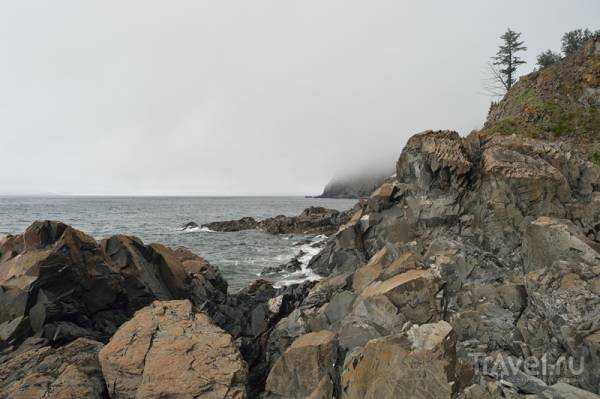
One day, out of curiosity, we took a stroll along the coast. The harsh, rocky landscape, almost devoid of vegetation, was even a little intimidating. A person among these rocks looked utterly small and helpless.


But the sky refused to clear. Because of the constant drizzle and the bone-chilling north wind, they began dining in the tent.
And all would have been well, but a real threat arose of getting stuck there, and for an indefinite period. In fact, later, one could say, that's exactly what happened. The helicopter never arrived on the appointed day. The next day, the weather proved equally unflyable.

Source: travel.ru