





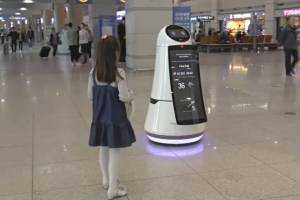

Scientists are confident that robots will replace airport staff by 2030, according to Travel Daily Media.
Robots will take over the world's airports in 12 years, according to a study conducted by Aira and Vero Solutions. According to experts, artificial intelligence machines Robots with intelligence will be responsible for check-in processes, have access to customer data in real time, and assess passengers' health and emotional state. More and more airports are using robots for cleaning or providing flight information. And more advanced technologies designed to take airport service to the next level are already being tested.
According to the British publication, artificial intelligence and chatbots (programs that imitate human activity) are gradually being implemented by airlines to process passenger orders and queries. The Bravo Oscar Tango robot, used by Air New Zealand, currently answers 67% customer questions. Kate the robot at Kansai Airport in Japan is an intelligent robotic check-in kiosk that autonomously navigates busy or congested areas of the terminal as needed. It analyzes traffic data to adjust its position, thereby reducing passenger wait times. Leo the robot can be found at Geneva Airport. He can check in passengers' luggage and issue boarding passes.
Many airports are already actively using robots for terminal cleaning and maintenance, as well as security. For example, at Incheon Airport in South Korea, a robot from LG Electronics is a large vacuum cleaner equipped with cameras and various sensors that help it navigate the terminals and remove debris.
According to scientists, from a security perspective, robots with facial recognition systems will be useful for detecting threats and apprehending criminals. The robots will also prove useful in emergency situations, such as detecting explosive devices. Similar machines are already in operation at Bao'an International Airport in Shenzhen. A security robot, Anbot, is operating there. Its purpose is to monitor departures, identify suspicious individuals, and assist people in finding their boarding gate.
One of the main arguments for replacing personnel with robots is their lower cost. However, human involvement in airport processes, as in any service sector, will remain important for a long time to come, the scientists conclude.
Source: news.turizm.ru