

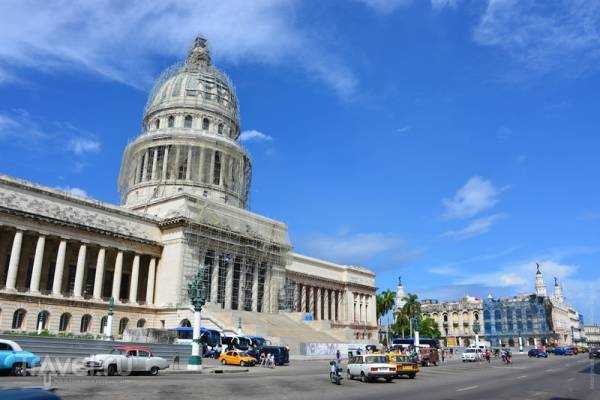

Strolling the streets of Old Havana is a pleasure. Spectacular palaces, Spanish colonial-style mansions, and luxurious American cars from the gangster era…
I was staying in a hotel near the Havana Capitol, so our tour will begin there. The Cuban Parliament building was built in 1929 and served until 1959, before the Cuban Revolution. It's a stunning palace, reminiscent of the US Capitol building in Washington, D.C.

The Cubans are quick to point out that their capitol is taller than the American one by so many centimeters... ) Today, it's undergoing a full-scale renovation, and the building is unfortunately closed to visitors. In general, many buildings in Havana are currently being renovated and put in order, and that's certainly great!

Take the neighboring Bolshoi Theatre, for example. The current building was erected here in 1915, replacing an older structure founded in 1838.

Opposite the theater is the small Central Park, opened in 1877. It was here that the first electric street lights in Cuba were installed (1899). And in 1905, a monument to Cuba's national hero, independence fighter, and poet José Martí was erected.

Around the park, waiting for tourists, are foreign-currency convertibles... And workhorses, sixes, fives, fours...

Older American vehicles are simpler and used in street transportation, as regular taxis. However, a more appropriate term is "minibuses."

José Martí (there are plenty of monuments to this national hero in Havana) overlooks the beautiful Paseo del Prado, opened here in the 1770s. Back then, it was a popular horseback riding spot for the aristocracy. The boulevard truly invites leisurely strolls. Here, artists display their own and others' paintings, a variety of souvenirs are sold, and everywhere you look you can hear the cry: "Hello! Where are you from?"

The buildings on the boulevard are built in the old Spanish style, with covered colonnades and passages that provide protection from rain and heat.

Of course, most of these buildings look rather sad.


The boulevard leads directly to the Malecon embankment, from where it is so wonderful to watch the ocean while sitting on a rock.

Yes, the reverse view is a bit confusing, but also pleasing at the same time.

The figure on the stone is the Cuban poet Juan Zenea, who took an active part in the struggle for Cuba's independence from the Spanish, for which he paid the price in 1871.

The architecture here is diverse and unique. Your eyes never have a chance to rest.

Havana was founded by Spanish settlers in 1515. Before the Spaniards, the Indians lived here freely, but in the following centuries they were almost completely wiped out, either by the Spaniards or by disease and famine. The Spaniards settled here thoroughly and for a long time. First of all, they built up the entrance to Havana Bay—convenient for ships—with two outstanding fortresses: San Salvador de La Punta (1582),

and El Morro (1589-1630) on the other side of the harbor. In the first case, on the site of a dense forest, in the second, on a rocky outcrop. Thus, the stronghold of Spanish rule in Cuba, as well as the main transshipment point for gold plundered in the Americas, remained impregnable until the end of the 19th century, with a brief interruption in 1762, when the British fleet briefly captured Havana.

Cuba's independence in 1902, now from both the Spanish and the Americans, fueled Havana's rapid growth, particularly during Machado's presidency (1925-1933). He pursued pro-American policies, and during this period, the city acquired recognizably American features in its architecture and infrastructure.

Until the 1959 revolution, Havana was actively being built up and rebuilt…

A little away from the fortresses, in a beautiful square, stands a monument to General Máximo Gómez, one of the fighters for Cuban independence and a comrade of José Martí. And the building on the right, by the way, is the Spanish embassy.
Behind the monument, a beautiful alley leads to the Presidential Palace, the residence of all Cuban leaders from 1920 to 1959. It now houses the Museum of the Revolution.

Opposite the museum are the remains of the city wall with the Baluarte de Angel watchtower.

The Museum of the Revolution's collection has long since expanded beyond the historic building. Just behind it, permanently parked right on the street, is a variety of military equipment from the Revolution, centered on a pavilion housing the legendary yacht "Granma." Designed to accommodate 12 people, it carried 84 revolutionaries from Mexico to the island of freedom in December 1956, including Fidel and Raúl Castro, Che Guevara, and others. I can just picture the scene...

Nearby is the new building of the National Museum of Art (on the right)

What's great about Havana is that there are so many real museum exhibits driving around the streets that you don't even need to go to the museum (a joke that's not without its meaning).

I decide to go deeper into the old city.

An incredible experience. Here, life is in full swing.

So far away and at the same time so close...)


After wandering aimlessly through the streets and alleys of Old Havana, I come to the right tourist trail,

to Cathedral Square. Founded in 1578, it draws my attention to the beautiful Cathedral of St. Christopher, built between 1748 and 1777. The remains of Christopher Columbus were kept here for many years.

Nearby is the palace of the Marquis of Agua Clara. The building was constructed in the 18th century as the marquis's residence. In the early 20th century, it housed the then-famous Paris restaurant and later a bank office.

Today it is the Spanish restaurant El Patio.

The Cathedral Square is a unique and fascinating place. Just step aside, lean against a column like Antonio Gades, the Spanish actor and flamenco dancer, and watch the people passing by.

Here's a young Cuban, the barker at El Patio restaurant, glancing at passersby, guessing from their faces the language they should use to address tourists. "Good afternoon" is often heard, too...

A hip artist sells his modest paintings in Cathedral Square. But are they his own?

And so we all gather together, watching the tourists: Some come for food; some out of curiosity; some want to connect with history, and for others, it's just their job...

A beautiful cathedral. Too bad it was closed to the public. I assume it opens at certain hours?

The street takes me along Hemingway-esque paths (the writer loved these streets and lived here),

The Plaza de Armas, the main historic square of Old Havana, is a square that originally served as a parade ground for the Spanish army, hence the name Plaza de Armas. It is considered the oldest square in Havana. In the center stands a monument to the "Father of the Nation." Carlos Manuel de Cespandes - This is another fighter for Cuban independence.

The El Templete Chapel (1828) was supposedly built on the very spot where Havana was founded. And it's customary to walk around the "sacred tree," the ceiba, touch it, and make a wish... It's said to come true only once a year—on the feast day of Saint Christopher, Havana's patron saint. Incidentally, you can still make your wish by November 15th in 2014.

There is a book market in the square, which, as far as I understand, is aimed not only at tourists. Many interesting-looking old editions are sold here, but unfortunately for me, they are in Spanish, which I don’t speak... I love places like this.

The courtyards of the Plaza de Armas lead me to the waterfront of Havana Bay.

There's nothing more pleasant than crossing the streets and avenues of the Cuban capital. There are probably never any traffic jams here!

I choose a nice direction and move on...

And then there's San Francisco Square, the Stock Exchange building, the Russian Orthodox Church Cathedral, and the vast expanse of Havana Bay. But more on that tomorrow.
Source: travel.ru