





Nestled among the protected oak and beech forests in a narrow gorge, surrounded on all sides by mountain ranges, lies one of the pearls of Armenia's Dilijan National Park – the Haghartsin Monastery…

Just 18 km from Dilijan, the road turns off the highway and takes us on a stunningly beautiful serpentine path to the upper reaches of the Haghartsin River, a left tributary of the Aghstev River…

The gorge is surrounded by sheer cliffs on all sides…

The foothills of these cliffs are painted with the amazing colours of autumn trees…

And along the bottom of the gorge, between the banks strewn with bright fallen leaves, the cold and transparent river Haghartsin runs, cheerfully playing with splashes on the rapids...

These cozy places have long been a favorite among Dilijan residents for their Sunday trips...

In the summer, families often come here for vacations or for walks along the mountain trails, the routes of which are indicated in the national park guidebooks...

Meanwhile, the serpentine road, after a few more twists and turns, unexpectedly offers us a beautiful view of the monastery itself. Founded in the tenth century, it flourished in the 11th-13th centuries and was the cultural center of medieval Armenia…

The medieval monastery's grounds are quite extensive. They include the Church of St. Grigor (11th century), the Church of St. Astvatsatsin (1281), the Church of St. Stepanos (1244), a 13th-century chapel, the burial vault of the Bagratuni royal family (12th century), a refectory (1248), and various monastic service buildings built in the 12th and 13th centuries.

Besides the architectural monuments of that era, the monastery is famous for its enormous, ancient oak tree, a local legend. Restoration of the complex, which began six years ago, was completed last year. A 2008 photo shows the same oak tree to the left of the main church…

There was a large, open hole in its trunk: it was believed that if you crawl through it, all your wishes would come true...

Last year, this living, thousand-year-old legend of Haghartsin burned down…
There is still no answer as to how this happened, who is to blame for it... The priests, the security guards, and the residents of the nearby village are silent...
Where were all these people looking and why didn't they do anything to stop the fire...
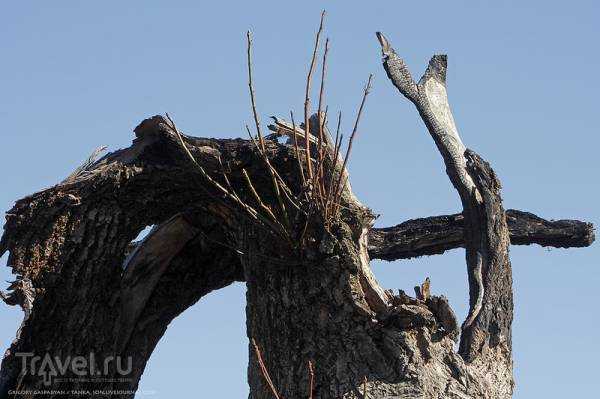
Today, all that remains of this amazing tree is a sawn-off stump, through whose bark new, slender shoots are beginning to emerge. The legend cannot be burned; it will live on in people's memories, in new shoots, and... in photographs...

The oldest structure in the Haghartsin complex is the Church of St. Gregory. It was built in the 11th century by monks fleeing persecution from Western Armenia, under Byzantine rule. The church itself is small and rectangular in plan. The interior is designed in the form of a cross. It is crowned by a conical dome on an octagonal drum. At the end of the 12th century, extensions were added to the church—a small blue basalt chapel with a vaulted ceiling, a narthex—a space combining a place of worship and burial…

In 1244, a small church of St. Stepanos was built – a miniature copy of the main church of St. Gregory…
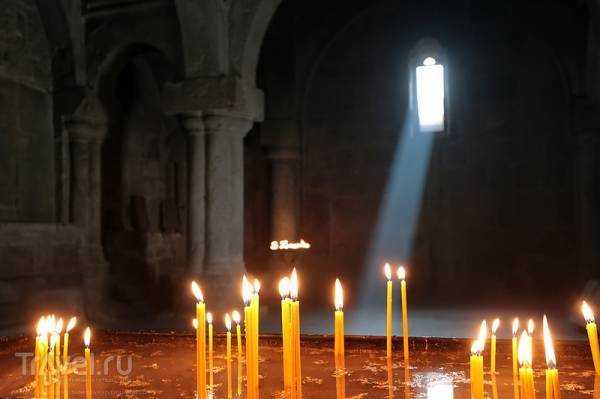
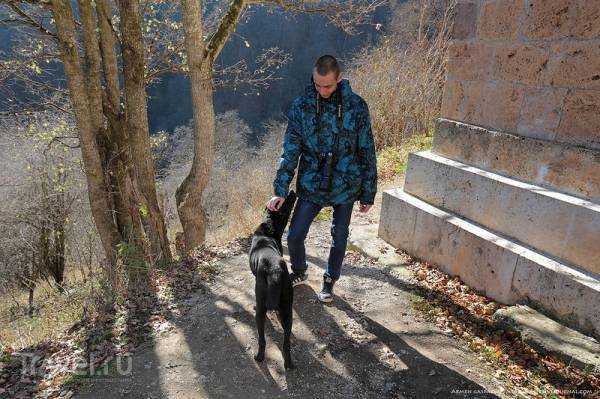
The local "security" was quite friendly, but of course they didn't refuse a piece of real Armenian Gata and followed us around without leaving our side.
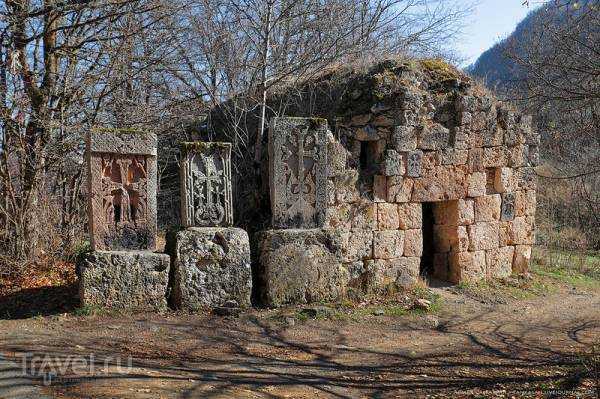
In the 13th century, the monastery was a major center of spiritual and cultural life in Armenia. The ruins of the monastery kitchen remain near the refectory, and the ruins of several chapels are visible on the approaches to the monastery. Near the southern wall of the narthex of the Church of St. Grigor, the foundations of two tombs of kings of the Kyurid dynasty remain, bearing the inscriptions "King Smbat" and "This is the tomb of King Gagik" (10th-11th centuries). Two kilometers from the monastery are the ruins of the medieval village of Haghartsin, which gave the monastery its name.
The volume of restoration work completed over the past eight years is quite extensive. Comparing the photographs, this is immediately apparent…

Today, Haghartsin is a fully restored complex with infrastructure and a good access road...

They also bake matnakash here—a traditional flatbread. Many people come here specifically for it, saying that only the monastery bakes such delicious ones…
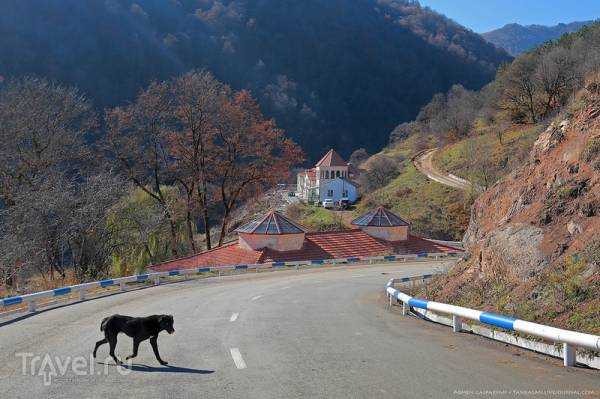
Many legends are told about Haghartsin. One legend speaks of countless treasures supposedly hidden within its walls and surrounding cliffs. But Haghartsin's greatest treasure is the beauty of its stone structures and the surrounding natural beauty of the Dilijan Reserve. In Armenia, they say that if paradise had forests, mountains, and mineral springs, it would look like Dilijan…
Source: travel.ru