

After seventeen unforgettable days in the Philippines, we flew to Bandar Seri Begawan, the capital of Brunei. Getting here without red tape is impossible. If you apply for a visa in Moscow, there's almost a 100% chance you won't even receive a response. But there is one loophole, which I'll explain later... Bandar greeted us with rain. What could be worse than bad weather when you're in an unfamiliar country for just two or three days? It's a good thing you can buy a simple umbrella in almost any store for just one dollar. Luckily, it only rained on the first day, and we saw all of Brunei's key sights.

This small, young state has an unexpectedly interesting history. Brunei wasn't always so small and inconspicuous. There were times when the country controlled almost the entire island of Kalimantan and even some territories beyond the island. There were also times when the Brunei army was a formidable force in the region, successfully resisting the Spanish colonization of Southeast Asia. And all this happened 500 years before the discovery of oil and gas, when power and greatness were measured by different standards. And if the leadership of the time had maintained its unity and prevented internal problems from leading the country into complete decline, everything would have been different. Naturally, the Europeans took advantage of the internal strife, strengthening their influence in Kalimantan, and from then on, Brunei dwindled, eventually nearly disappearing altogether. Two regions of neighboring Malaysia, Sabah and Sarawak, were still considered Brunei territory in the second half of the 19th century. Through some convoluted machinations, both regions ended up under British rule. Brunei itself fell into complete dependence. The Sultan retained his regalia and exercised authority over his people, but he couldn't take a single step independently without consulting the British Empire.
View of Bandar Seri Begawan from the Brunei River:
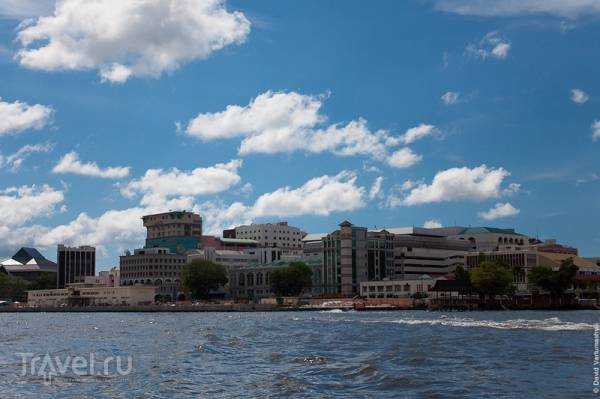
The region's importance increased exponentially with the advent of oil production in the late 1920s. This is precisely why Great Britain, having easily disposed of many "unprofitable" colonies and granted them independence, was so slow and reluctant to make concessions on recognizing Brunei's independence. Initially, there was a plan to unite the territories of modern-day Malaysia, Brunei, and Singapore into a federation. To resist this, an armed uprising even broke out in Bandar Seri Begawan in 1962, directed, among other things, against the then Sultan Omar Ali Saifuddien III, who supported the idea of unification. The uprising soon engulfed the entire territory of modern-day Brunei and even spread to neighboring regions. The leader of the uprising, Sheikh A. M. Azahari, failed to become a national hero; he is not remembered; he was expelled from the country, although he is undoubtedly a key figure in Brunei's history. The Sultan himself capitalized on this coup attempt, declaring his refusal to join the federation and voicing what the poor Azahari had been seeking—a desire for complete independence. This all occurred against the backdrop of the discovery of new oil fields and an unwillingness to share the proceeds. Negotiations dragged on for years, with the British stalling, receiving tens of thousands of tons of oil and millions of cubic meters of gas daily. To preserve his statehood and his dynasty, the Sultan was forced to renounce his claims to Sabah and Sarawak, more than 951 TP3T of the country's territory, and, under pressure from Britain, abdicated the throne in favor of his son, the current Sultan, Hassanal Bolkiah. Remaining his son's chief advisor, he influenced his country's policies for the rest of his life. Omar Ali Saifuddien lived to see Brunei's complete independence declared, piecemeal, begged, and bought from Britain. It happened on the night of January 1, 1984. Then, before a crowd of thousands, Sultan Hassanal Bolkiah proclaimed Brunei's full sovereignty. This event had been awaited for more than 30 years, and the price paid for this independence was considerable.
Brunei's population is made up entirely of Chinese and Malays (it's hard to tell which is which). They speak Malay, but English is also no problem. Personal observation: people are all neat and clean. No homeless people were spotted.
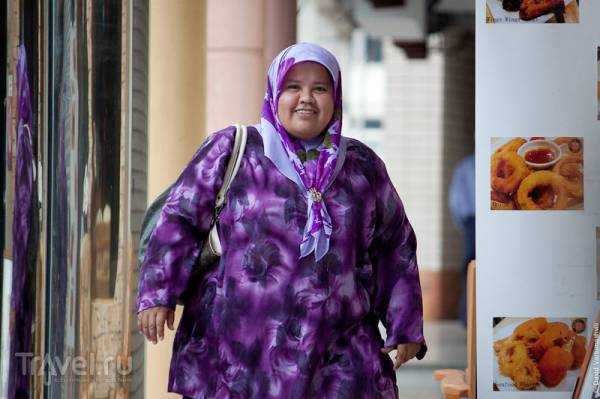
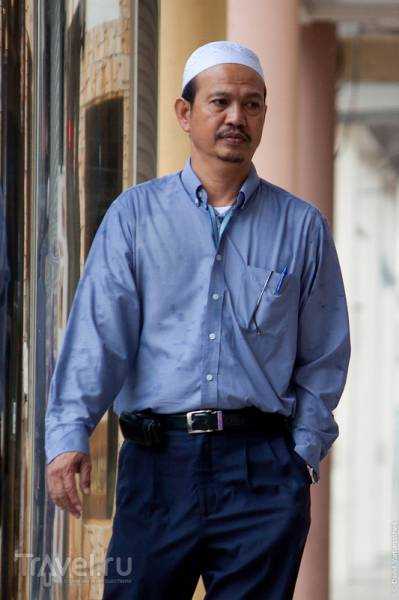
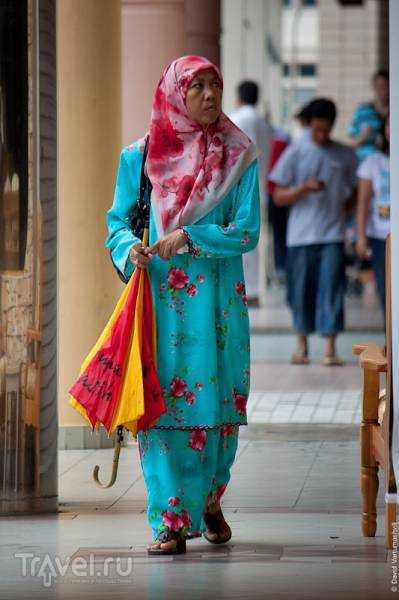
It seems to be a Muslim country, but no one pays attention to the slight freedom in clothing.
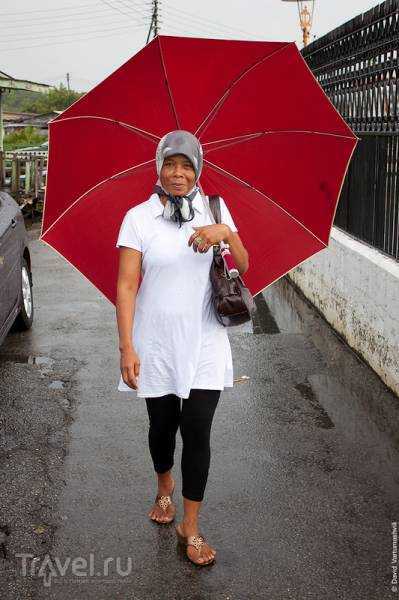
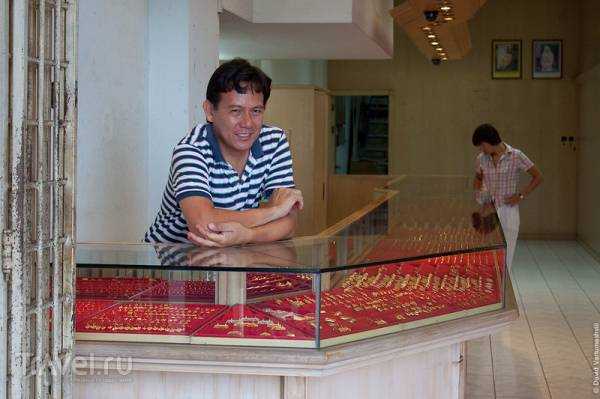
Gold seller.
The country's capital, Bandar Seri Begawan, is a small but very charming town. The first settlements on both banks of the Brunei River appeared here as early as the eighth century, but no antiquities from that era have survived. The fishing village of Kampong Ayer, located on the opposite bank of the river from the mainland, can be considered the historical part of the city. "On the bank" is a rather loose term, as all the houses are built directly on the water, on stilts. This is where fishermen and artisans—the poorest segment of the population—continue to live, and we'll visit it in the next section. The modern city is the direct opposite of the "floating city," but unlike the latter, it doesn't feel like a residential place—yes, the usual business life of a capital city rages here, but there seems to be no housing as such. Residents inhabit the outskirts: the poorer ones live in Kampong Ayer, while the rest have acquired mansions in the suburbs, where a huge private sector has been built—its impressive size is visible from the window of a landing plane.
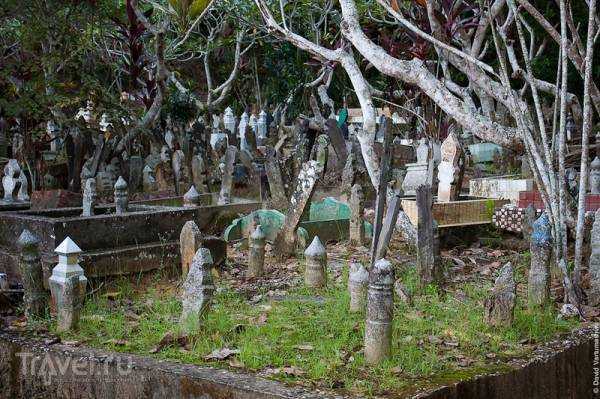
The only thing that might seem ancient is the Muslim cemetery on the outskirts of the city. Those interested can also visit the graves of Brunei's previous sultans. The current sultan's father is buried near the Brunei Museum on the outskirts of the city, and nearby are the truly ancient mausoleums of Sultans Sharif Ali (died 1432) and Bolkiah (died 1524).
Streets of Bandar:
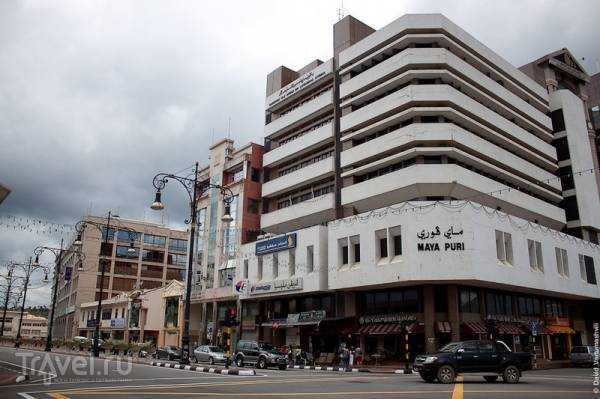
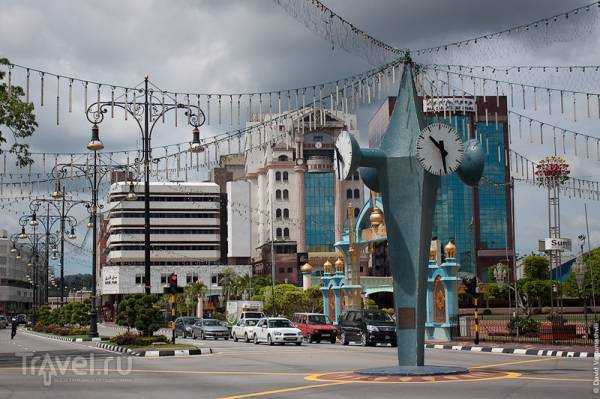
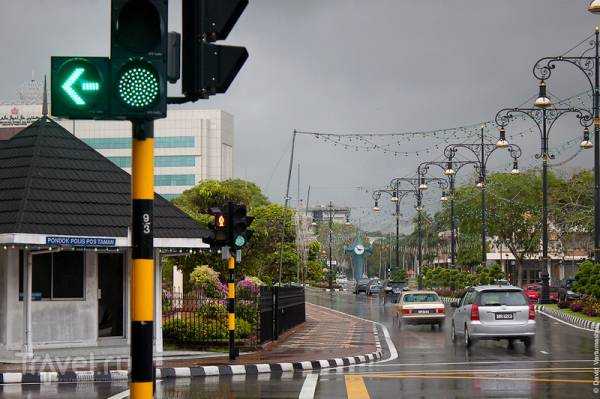
At night:

In the very center, there are several high-rise office buildings (it's hard to call them skyscrapers). One of the largest structures here is a multi-story parking lot, offering panoramic views of the entire city, but they say getting to the top isn't always possible—vigilant guards keep you away. I haven't tried it, though, so this information is based on secondhand accounts.
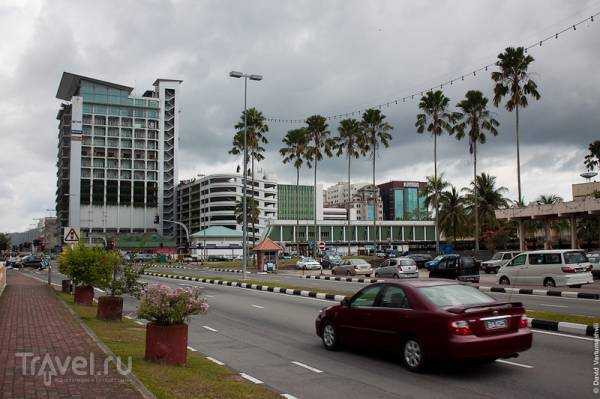
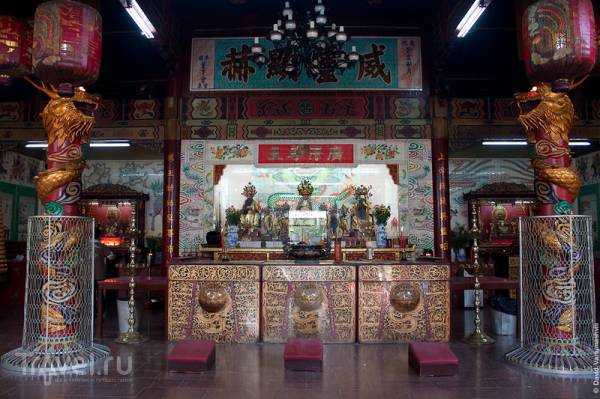
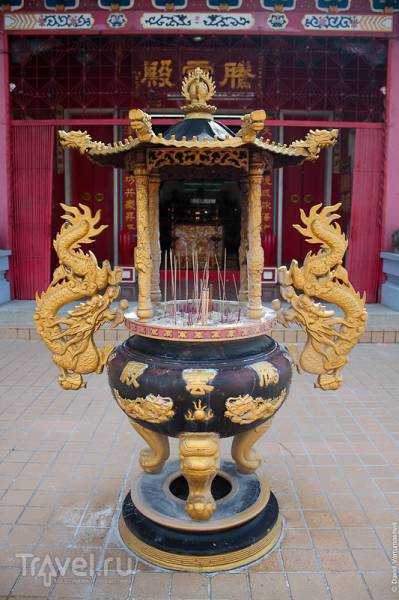
There's a barely noticeable Chinese Buddhist temple under the parking lot. It seems to be very old, but I couldn't find any confirmation.
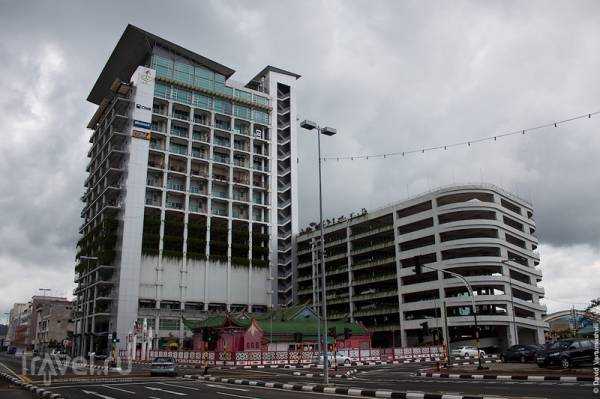
The temple has a rather unflattering neighborhood: a parking lot overshadows it, making it completely unphotogenic. Inside, however, it's beautiful, and there are no visitors:
Speaking of churches... The capital was formerly called Brunei Town or Bandar Brunei, but in 1970 the city was renamed in honor of the former sultan, the same one who abdicated in favor of his son after a failed coup. Bandar Seri Begawan translates from Malay as "His Excellency's City." And although Bandar has been inhabited since time immemorial, the city acquired its modern appearance only recently. As a taxi driver who was born and lived here his entire life told me, just 50 years ago everything looked completely different, with mostly wooden houses standing here. This peaceful, rural picture was shattered by the enormous building of Bandar's main landmark, the Sultan Omar Ali Saifuddien Mosque, after whom the city itself is now named.
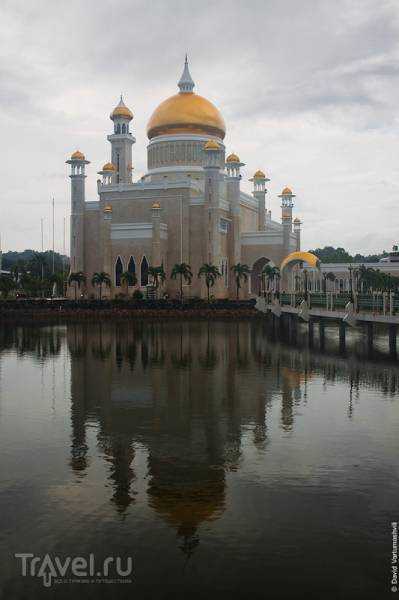
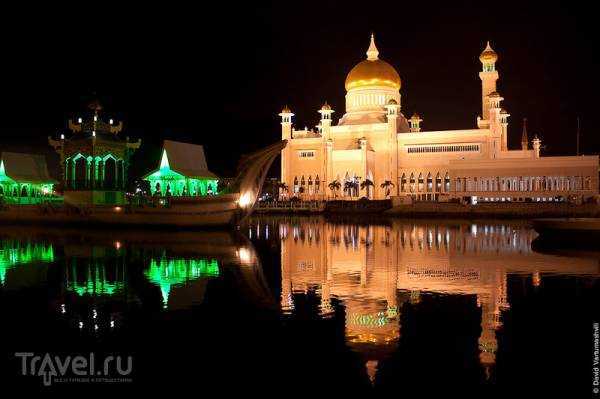
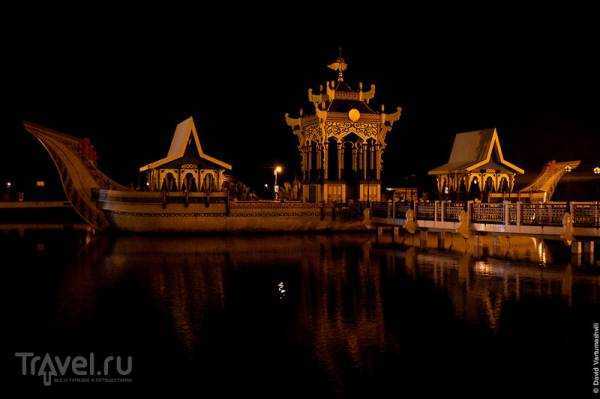
This royal mosque is the city's symbol and tallest building. Completed in 1958, it was finished with expensive imported materials, primarily granite and marble. The domes are covered in pure gold. The building is also unique architecturally, blending Islamic and Italian styles (the architect was Italian). The mosque is located in a fenced artificial lagoon. A bridge spans the lagoon to a small neighborhood consisting of several dozen floating houses. Another marble bridge leads to a stone boat used for ceremonies. Together, they are a hallmark of the city and the country as a whole. It is a truly beautiful place; on certain days, you can even enter the mosque and climb the minaret.
At night, all of this is beautifully illuminated:
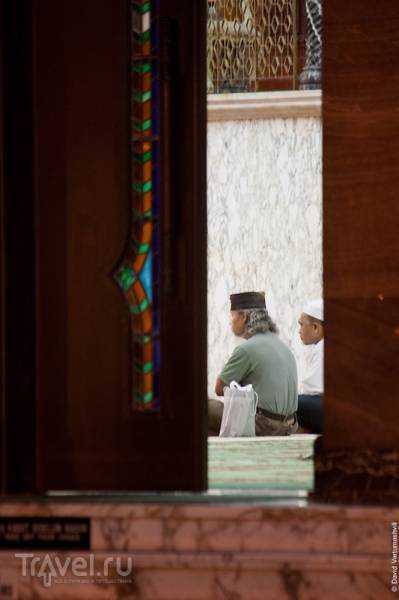
I peeped through the open door at the evening prayer:
Ceremonial boat:
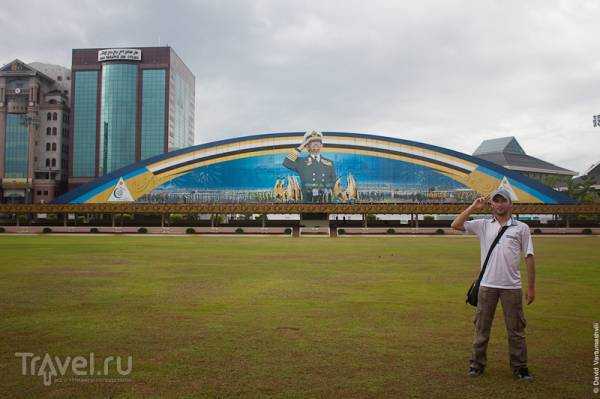
This place offers a glimpse of the unexpected contrast that so astonishes Brunei. On one side of the Sultan Omar Mosque is a gigantic shopping mall, empty of visitors. And on the other side is the ponderous Taman Haji Sir Muda Omar Ali Saifuddien, formerly known as Padang Besar (Great Field). All city ceremonies and parades are held on this field. And when the Sultan himself is not present, a giant portrait of him overlooks the participants, reminding everyone that Brunei is an absolute hereditary theocratic monarchy.
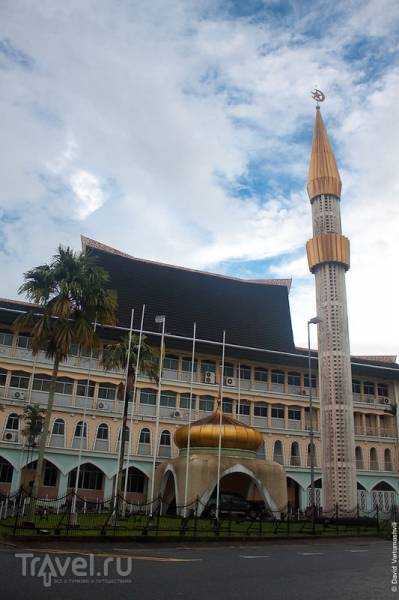
A building next to a mosque. It doesn't look like a mosque, but it does have a minaret.
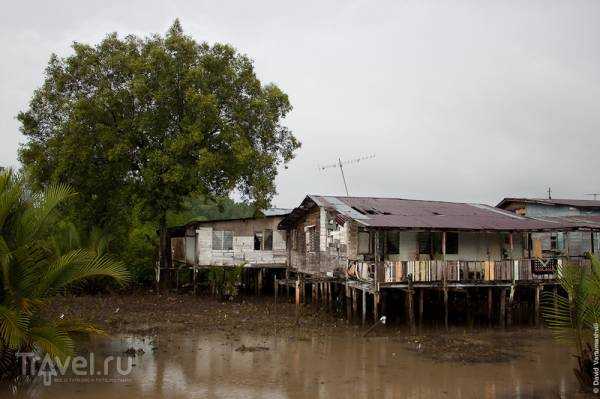
And on the other side of the mosque, the bridge across the lagoon ends at houses like these with rusty roofs. And this, mind you, is housing in an elite area of the capital of one of the richest countries in the world, not some banana republic:
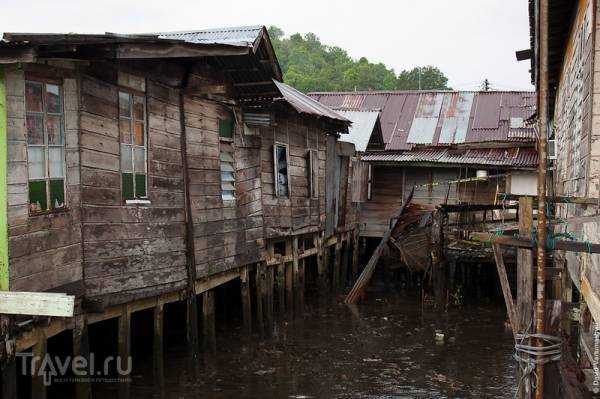
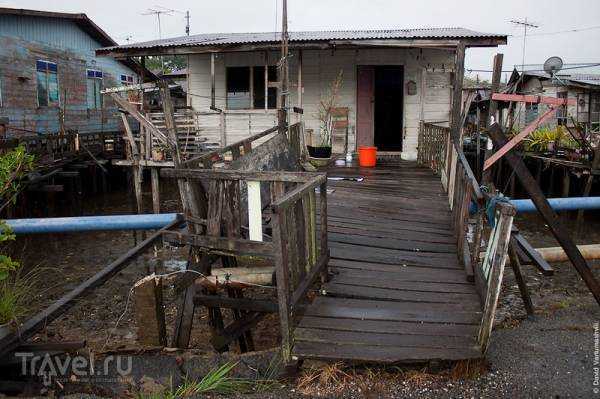
It's hard to imagine, but citizens of a state whose per capita GDP is much higher than Russia's actually live here.
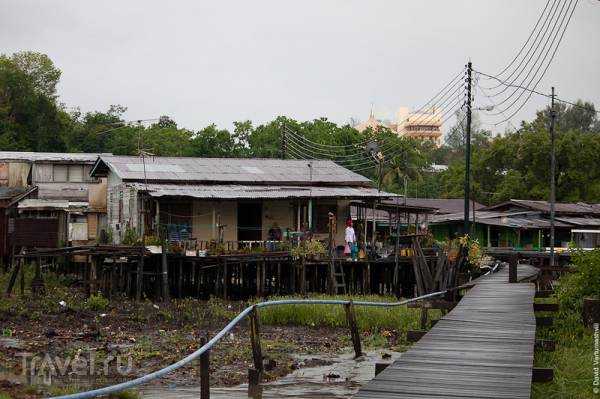
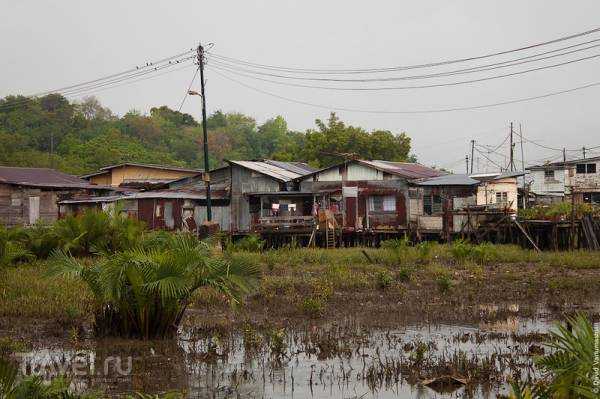
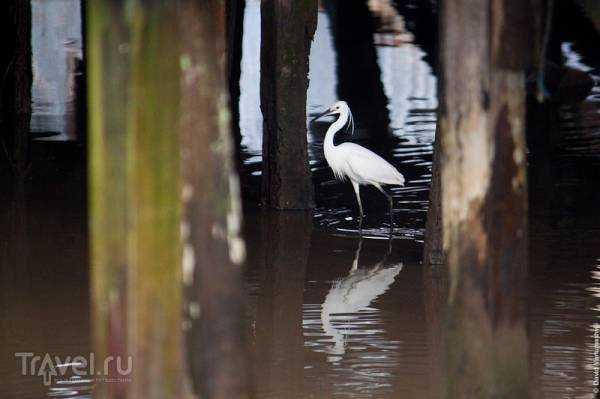
There must be quite a few frogs here:
Source: travel.ru