

My journey through Southeast Asia began in Laos. My starting point was Luang Prabang, the ancient capital of Laos and now the country's most visited city by foreign tourists. Before the trip, I was terrified of tropical cockroaches and malaria-carrying mosquitoes. Luang Prabang had neither, but it was full of monks, tourists, souvenirs, and landscapes straight out of a colonial detective story.

On board the plane from Bangkok, all the passengers were wearing seat belts, no one was standing in the aisle, carrying bags of food, smoking, or making noise—nothing out of the ordinary. The small, modern Airbus was filled exclusively with European tourists. After a long, beautiful sunset landing over the Mekong River, the plane touched down on the concrete runway and stopped in front of the neat, new Luang Prabang Airport. The airport was so small that my boarding pass had a blank space where the city's name should have been. In Nuremberg, where I checked in for the flight, they didn't even know the name of the city with such a small airport!
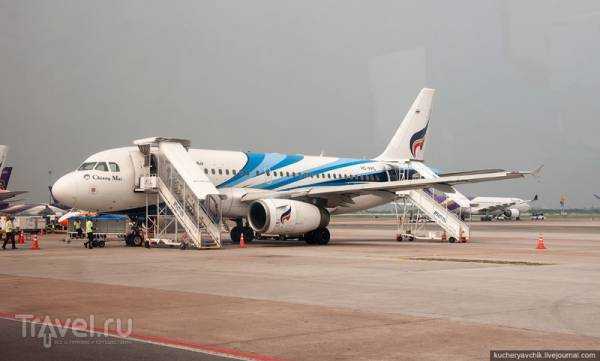
My guidebook said that photographing "restricted areas" in Laos was prohibited, which included airports (there are no train stations or metro in Laos). I peered cautiously out the plane's window, but didn't see a single soldier on the tarmac. A Bangkok Airways flight attendant opened the door and ushered the passengers out onto the tarmac. We walked to the terminal. Plastic windows, windows of hideous blue glass—everything looked too normal and perfect for one of the poorest countries in the world. There were no soldiers in sight.

On the airfield, I breathed in the tropical South Asian air for the first time. I'd been warned that April in Indochina would be hard to breathe. It's no coincidence that April is the least visited month of the year. June marks the beginning of the rainy season, and by the end of April, the humidity reaches almost 100%, but no rain falls, making it very difficult to breathe. Within minutes, your body is covered in sweat. After a while, you stop wiping your forehead—your skin will remain perpetually damp until I leave Indochina two weeks after arriving in Luang Prabang. Now, as I write this report in November, wrapped in a blanket with a cup of tea, weather.com shows a stable 31°C in Luang Prabang. Brrr!

The air conditioning was on inside the terminal. The clean marble floor gleamed so brightly you could see up the women's skirts! Passengers lined up in two lines: one for visas, the other for those who already had them. Citizens of many countries, including Ukraine, can obtain an entry visa at the airport upon arrival. The border guard was polite but laconic. The Lao government official reached below my shoulder, but the cabinet he was hiding behind was taller than him. Another law enforcement officer strolled along the line. The airport and the presidential palace are the only two places where you can see military personnel in Laos. Generally, there are very few police in Laos. You don't see any on the streets at all. Once, I took a photo of a policeman. Later, it turned out he was a volunteer. I saw my first police car in Southeast Asia a week later in Vietnam. In Laos, you could take photos everywhere!

Luang Prabang is the most visited city in Laos, and most tourists begin their exploration of the country from here. Tuk-tuks and taxis were crowded in front of the airport. I hopped into a minibus with three guys from Europe already in it. The driver took us all to our hotels. At each hotel, he stopped at an intersection and asked passersby for directions. There are no street names in Laos; orientation is based on landmarks and distinctive building characteristics. For example, the blue house toward the river from the "wat parawat" temple will lead you to your destination much faster than "Sikhom Road 35" as printed in a guidebook. I'll tell you an unforgettable story about Sihom Road when I write a report about Vientiane.

As soon as the minibus had driven about three hundred meters from the airport, the paved road ended and a standard potholed, dusty road began. The driver avoided potholes, then we missed the bridge over the river and found ourselves in the city center.

The old part of Luang Prabang lies on a cape formed by the confluence of the Nam Khan River and the Mekong. Dozens of ancient monasteries and stupas are located within this limited area. A stupa is a sacred site for Buddhists. There are many temples throughout Laos, but Luang Prabang has the highest density of stupas per square kilometer!

All the monasteries are very similar to each other. Perhaps this has something to do with Buddhism. Architecture in Asia is generally very uniform. The three types of stupas described in my guidebook were so subtly differentiated that an inexperienced tourist would have been unable to distinguish them at all. Unlike European architectural heritage, in Asia there was no division into Renaissance, Baroque, and Art Nouveau. Externally, it is difficult to discern any development in the architecture of Buddhist monasteries. In this respect, they are more like Orthodox churches, built in the 21st century according to the same unwritten canon as four hundred years ago.

The monasteries are so similar that I had a hard time sorting the photos by location. Each monastery is centered around a main church and surrounded by a low wall.
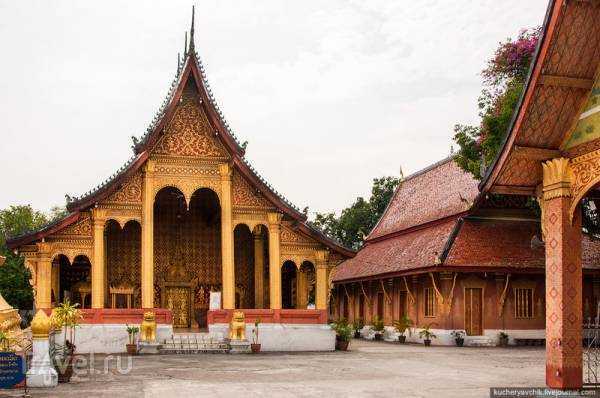
The rectangular temple is crowned with a triangular roof, which rests on columns.

Inside the temple stands a gilded (or simply gold-painted) statue of Buddha. Smaller Buddhas often stand at the Buddha's feet. Temples are painted in vibrant colors, often a combination of gold and red, as red is a lucky color according to Buddhist beliefs. In general, religious symbolism and church decoration in Asia is very colorful, with a pronounced tendency toward gilding.


The monastery grounds are dotted with pointed, cone-shaped stone structures. They are typically ornately decorated and often painted gold.


The most pleasant impression of the temples was left by the monks. In Laos, they are usually young men. Some of them are learning foreign languages—French, English, Japanese—and you can strike up a conversation with them. The monks are very positive and friendly.


Mount Phu Si rises in the very center of Luang Prabang. There's an entrance fee, as the path to the summit passes through the rock monastery Wat Thammothayalan. One of the small temples houses a Buddha footprint—a stone impression measuring one and a half meters in diameter. There's also a cave where you can pray to the Buddha, as well as numerous gilded Buddha statues displayed in a variety of playful poses. The Tuesday Buddha, for example, is actually lying on a sofa!

At the very top of Phu Si is another pointed Buddhist temple, a rusty cannon from the Vietnam War, and a small observation deck.

The landscape around Luang Prabang perfectly matched my expectations of a jungle city. Karst mountains shape the landscape. The horizon is dotted with small houses with sloping roofs amidst thickets of palm trees. To the west, the city faces the Mekong River, with its elongated boats floating along it. It's reminiscent of a newsreel from the Vietnam War.

Incidentally, Laos also suffered during the Vietnam War. Some ammunition for communist guerrillas was delivered to South Vietnam through the Laotian jungle, and the American military command decided to bomb Laos. In some regions of the country, especially in the north, people hid from the bombings in caves and sometimes even lived there for years. This criminal story is still hushed up in the West.

Back at the mountaintop, I observed an interesting Laotian custom. An old woman was selling caged birds on a ladder. The cages were made of some kind of strong, exotic stem. So strong that the birds, trapped between the bars, quickly lost their strength trying to escape the cage's confines, especially on a tropical afternoon. Adults and children alike would buy the birds, walk to the cliff, and open the bottom of the cage. According to legend, the bird was supposed to fly free, but instead, a dead body would often fall out of the cage and roll into the bushes. The boy sitting next to the old woman would jump up and run down into the bushes, where, a minute later, he would retrieve the abandoned bird and push its body back into the cage.

The photographs show a dense haze hanging over the city the entire time. The combination of heat and very high humidity causes moist air to rise from early morning. But since the rainy season hasn't yet arrived, the moisture doesn't fall to the ground and continues to hang in the air, forming an unpleasant, sticky layer on the skin.

In the past, Luang Prabang's population consisted almost exclusively of monks. Dressed in orange robes, the monks lived their Buddhist way of life. Buddhism forbids monks from possessing worldly goods, so their survival depends on alms from parishioners. Every morning, monks walk in a slow procession through the streets of Luang Prabang, collecting rice, which locals hand over to them at dawn. Tourists eagerly participate in this ancient ceremony. The guidebook asks tourists not to turn the religious ceremony into a "monkey photo" and to refrain from taking photographs.

Luang Prabang's center is roughly divided into squares. Each square includes several streets surrounding a single monastery. Locals navigate by the names of the monasteries. Surprisingly, amidst this chaos, the postal service works! My postcard reached its destination in Ukraine after just three weeks!

Luang Prabang was the capital of the Lao Kingdom until the 17th century. Over the centuries, the city was contested by the Thais, Khmers, and French. In the Middle Ages, Luang Prabang was the capital of the Kingdom of a Million Elephants, a state in Indochina largely coextensive with modern-day Laos. Until the last days of the monarchy, the royal residence was in Luang Prabang, and the city was called the royal capital of Laos. The history of the Lao Kingdom ended with the victory of the communists in Laos in 1975.

Since ancient times, Luang Prabang has been the spiritual center of the region. Dozens of monasteries were located here, and the monastic way of life largely shaped the city's life. The importance of these numerous ancient monasteries prompted UNESCO to place the entire central part of the city under protection. Since Luang Prabang was added to the prestigious World Heritage List, the city has changed significantly. Many ancient monasteries have been renovated, streets have been paved, and sidewalks have been installed along the main roads—a completely unusual architectural form for Laos. Antique lanterns and decorative fences have been installed along the paved sidewalks. Zebra crossings have been painted at intersections. In short, Luang Prabang has been thoroughly renovated in the European style.

At the same time, a promenade overlooking the Mekong opened in the city, and many restaurants catering to Europeans opened. Here you can dine with a view of the Mekong. Just don't lean over the fence. The entire mountain, like all of Laos, is littered with trash. Trash is a real scourge of Laos.


Source: travel.ru